

Aquarium Power Outage: What to Check Before and After
The power goes out and the filter falls silent. “How many hours can the fish survive?” is often the first question. There is no reliable single time for every aquarium: stocking, species, temperature, water movement and the starting water quality all matter. Look at the tank’s current condition before relying on a countdown.
This guide covers freshwater aquariums. If fish crowd the surface and show clear breathing distress, do not delay aeration support. Use an aquarium-suitable air pump that can operate independently of mains power if one is available. A second filter plugged into the same mains supply is not backup for a general outage.
Establish what stopped and what still runs
The filter, air pump, heater, cooling fan and CO₂ controls may stop together; some may have backup power. Check actual water movement and airflow rather than sound alone. Do not assume how your CO₂ system behaves during an outage or when power returns. If circulation has stopped, safely stop CO₂ injection and observe livestock.
Do not handle wet connections or damaged equipment. Follow the manufacturer’s safety instructions before working on a device. If an aquarium electrical fault may have caused the outage, seek qualified help rather than repeatedly trying to switch equipment back on.
Watch aeration and temperature together
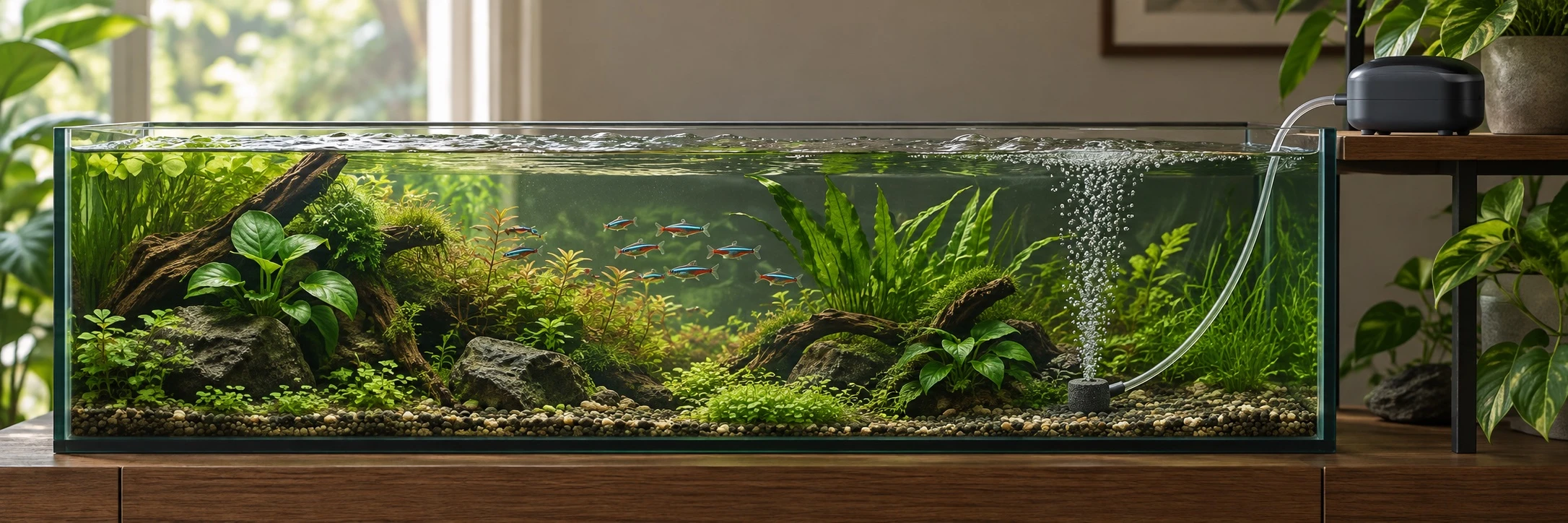
Operate backup aeration according to its instructions. Confirm that the airline is connected, the air stone actually produces bubbles and the surface moves. Check battery or charge status. A stated runtime is not a measurement from your particular setup. Our sponge filter guide explains air-driven filtration; adding a pump does not instantly establish biological capacity that was not already present.
Measure temperature and follow its direction. Depending on the season, warming as well as cooling can matter. Avoid sudden corrections by pouring in hot water or adding ice. If an extended outage prevents suitable temperature and aeration, arrange experienced help for safe, prepared temporary care. Rushing livestock into an unprepared container can create another problem.
Avoid adding waste or starting major maintenance
A brief feeding pause may reduce new waste for healthy adults while filtration and water movement are interrupted. Fry and specialised feeding needs require a separate decision. Do not compensate with extra food immediately afterwards.
Cleaning the entire tank, replacing all media or adding random products is not an outage plan. Remove accessible decaying food or dead animals. If livestock look unwell, check water quality and use a partial change with suitably prepared water when needed, following our water change guide. A change does not replace aeration or temperature monitoring.
When power returns, a motor noise is not enough
Has the filter actually restarted moving water? Is a HOB filled correctly? Has a canister trapped air? Is the output adequate? Follow the model’s restart instructions and do not let it run dry. Investigate leakage, overflowing or an unusual sound rather than leaving it because the motor runs. Our HOB filter and canister filter guides explain their basic differences.
After a prolonged or unknown stoppage, the water held inside an enclosed filter may also need assessment. Do not blindly send stagnant filter water back into the aquarium; follow model-specific maintenance and restart guidance, or seek the manufacturer’s support. Smell and clarity alone do not establish safety. Protect the media and do not let it dry; if maintenance is required, use our filter cleaning guide.
Check lighting, heater, fan and CO₂ schedules too. A timer may have reset. Restored filtration does not prove CO₂ can safely resume at the old setting without checking; assess it while you can observe the aquarium.
The outage has ended; follow-up has not
Record the start and end times, temperature, livestock behaviour and which devices restarted. If the outage was extended, its duration is unknown or animals were affected, test ammonia and nitrite and compare subsequent readings. One reassuring initial result is not sufficient reason to abandon follow-up.
Flow may be restored before water quality or animal behaviour recovers. Persistent respiratory distress, deaths or rising readings calls for experienced aquatic-health support. Our biological filtration guide explains why running equipment and adequate processing capacity are different questions.
Write the next outage plan now
Know where backup aeration is stored, how its battery or charging arrangement works, where the equipment manuals are and which maintenance supplies you need. If backup equipment claims automatic startup, verify that behaviour with a suitable check that does not put livestock at risk.
You can note the outage, its effects and the actions taken in your NeoMa tank journal. Future preparation can then use the response of your own aquarium rather than only a remembered duration. The aim is to reduce uncertainty through observation, prepared equipment and regular checks, rather than promise an exact survival time.