

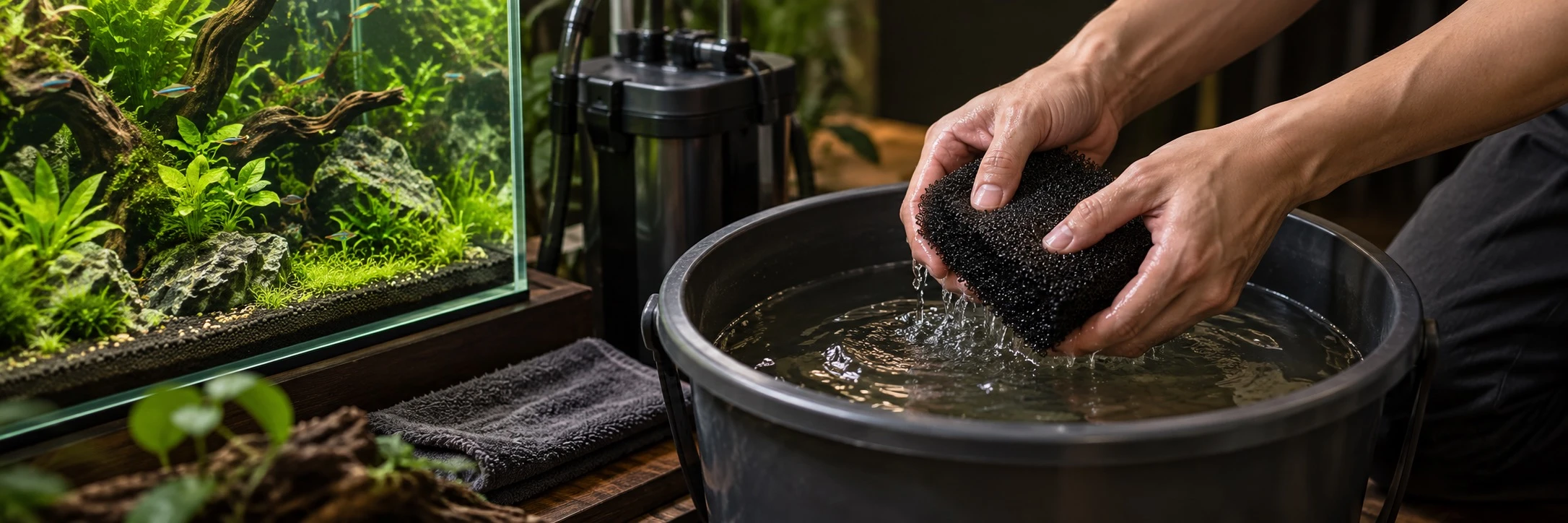
The filter output has weakened, and you are wondering what to clean. Start by finding where the flow is being restricted: the intake guard, the foam, a bent hose? Useful maintenance removes accumulated debris and restores the water path while preserving established biological surfaces where possible.
When does it need cleaning?
A calendar is useful as a reminder, but tanks collect debris at different rates. Compare the intake guard and output with their usual condition. When flow weakens, start with the parts that are easy to inspect. Sometimes a blocked intake explains part of the problem without opening the entire housing.
Preparation before you start
Prepare an aquarium-only container, appropriate cleaning tools and a work area. Set aside suitable water for media before disassembly. Avoid containers with detergent residue. For a canister, read the valve and hose-disconnection procedure and prepare for spills. Stop equipment safely according to its instructions. Do not open connections blindly if you do not know how much water could escape.
Cleaning foam and media
Remove accumulated debris from foam using aquarium water or appropriately dechlorinated water. The aim is debris removal, not detergent cleaning or sterilisation. Keep biological media from drying during maintenance. Follow the model’s staged-maintenance guidance where it has several sections.
Breaking floss or foam that has lost its structure may require replacement. Intact brown foam should not be discarded for colour alone. Assess each material separately.
Impeller, hoses and outlets
Clean the impeller and chamber using suitable manufacturer-approved tools. Keep track of small shafts, bearings and seals. Avoid unapproved lubricants. Check tubing and outlets too: clean media cannot compensate for a blocked outlet. If a canister seal is worn, use compatible parts and follow servicing instructions. Forcing connections tighter is not a reliable response to seal-related leaks.
Do not finish at restart
Reassemble baskets and connections correctly. Perform required filling or priming without running the motor dry. Check actual output, leaks and unusual sounds. Hearing the motor does not prove that water is moving properly. Follow water tests after significant media work. Do not dismiss breathing difficulties in livestock just because the filter is switched on.
Example: flow remains weak after cleaning
Cleaning foam does not restore flow. Rather than repeatedly squeezing it, inspect other parts: the guard, a kink, a valve or outlet deposits. Follow safe disassembly instructions if the impeller needs attention. Assess temporary tank circulation needs instead of leaving the filter off while shopping.
Frequently asked questions
Is never cleaning safer?
No. Deposits can affect flow. Remove debris while preserving established media.
Can I wash media with soap?
Do not use soap or detergent on filter media; clean it with suitable water. For the basic jobs of filtration, see our Aquarium Filter Guide.
What should you record in NeoMa?
List the parts serviced: foam, intake, impeller, tubing or baskets. Record replacements separately, with before-and-after output and leak checks.
How can you tell it helped?
Steady return, dry connections and normal sound suggest the mechanical maintenance goal has been met. Continue tests after major media work. Rapid renewed blockage warrants investigating food and debris input.
Following this in your own tank
Keep a small, useful maintenance record: what was cleaned, what was replaced and how the flow changed. Adding that to your tank history in NeoMa can help plan the next service. If the interval keeps shrinking, also look for the source of the buildup.