

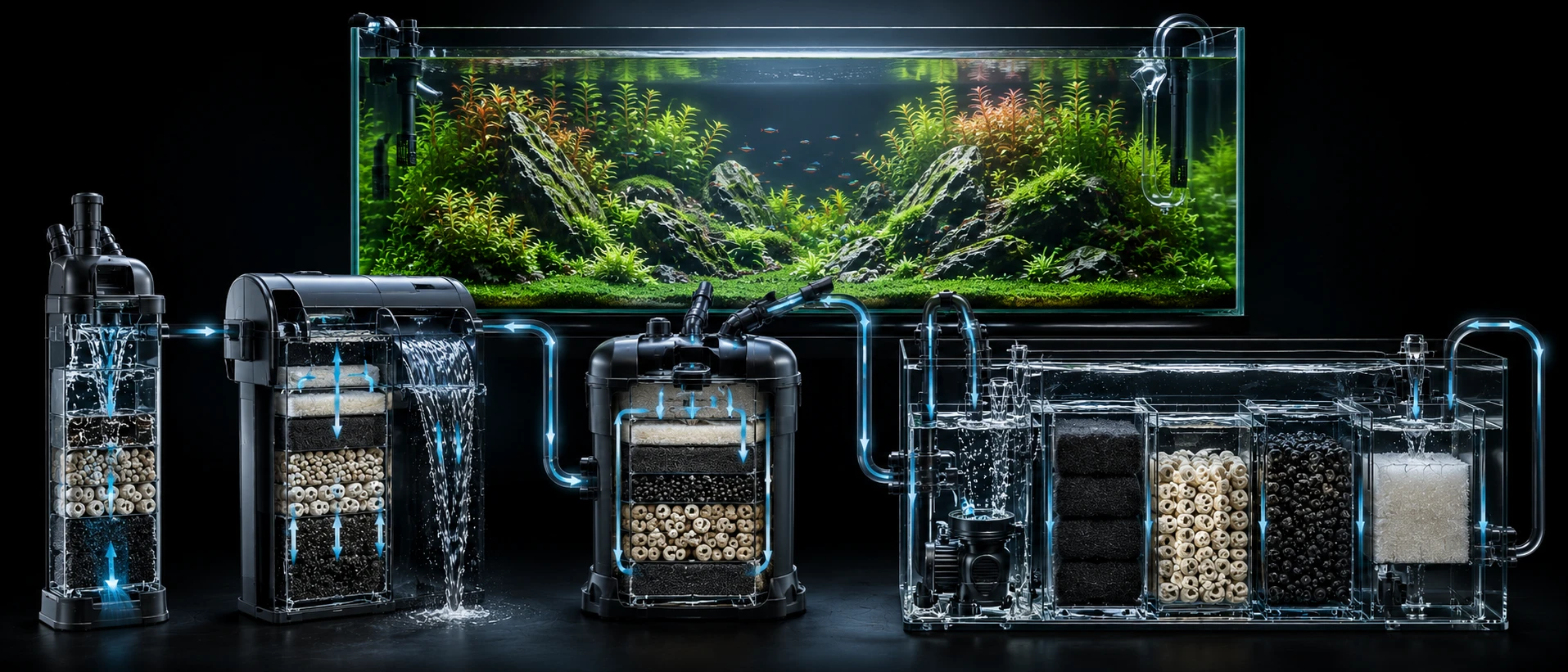
The filter is running and the water looks clean. Good—but there is more going on than the view suggests. Foam catches particles, while established surfaces provide space for microorganisms involved in processing waste. Understanding the filter helps explain how the tank handles its daily load, as well as why the water looks clearer.
What is a filter?
A filter is a system through which aquarium water passes so that filter media can perform particular functions. These are usually described as mechanical, biological and chemical filtration. Not every aquarium needs every type of media.
Mechanical filtration
Mechanical filtration traps suspended particles such as uneaten food, plant fragments and waste. Foam and filter floss are common examples. Trapped material remains in the system until it is removed during maintenance; collecting it is not the same as eliminating it.
Biological filtration
Microorganisms colonise filter media and other wet surfaces throughout the aquarium. Nitrification converts ammonia to nitrite and then nitrate. A filter helps by providing surface area and water flow, but it is not the only place where this happens. New media does not immediately have the biological capacity of an established filter.
Biological filtration is therefore about supporting an established microbial community, not simply buying a larger pump. Media capacity, water flow, oxygen availability and the load placed on the system all matter.
Chemical filtration
Chemical media remove particular dissolved substances through mechanisms such as adsorption or ion exchange. Activated carbon, specific adsorbent resins and zeolite have different purposes and limitations. They should not be treated as interchangeable products or assumed to be necessary in every aquarium. Follow the relevant product instructions.
Can you keep an aquarium without a filter?
Some carefully managed, lightly stocked planted systems operate without a conventional powered filter. That does not make filtration unnecessary in every setup. For a beginner, a suitably selected filter generally provides a more manageable approach. Animal requirements, feeding and the rest of the system still determine what is appropriate.
What makes a filter suitable?
A suitable filter provides usable media space, appropriate circulation and safe intake, and can be maintained reliably. It may help surface gas exchange and collect suspended debris. Price and motor power alone do not determine suitability.
Common mistakes
Judging water quality only by clarity.
Replacing all established media during routine cleaning.
Cleaning biological media with untreated chlorinated water or allowing it to dry.
Choosing the strongest pump without considering flow distribution and animal requirements.
Frequently asked questions
Should a filter run continuously?
Routine aquarium filtration is generally intended to operate continuously. Repeated overnight shutdown interrupts circulation and filtration. Investigate noise or maintenance problems instead of making shutdown a daily habit.
What is the best filter?
There is no single answer. Consider stocking, feeding, tank layout, media capacity, intake safety and access for maintenance together.
Following this in your own tank
Choosing a model is only part of the job; suitable installation and consistent care matter too. Follow normal flow, service dates and water readings together. That gives you a view of the tank over time rather than relying on one image or number.