
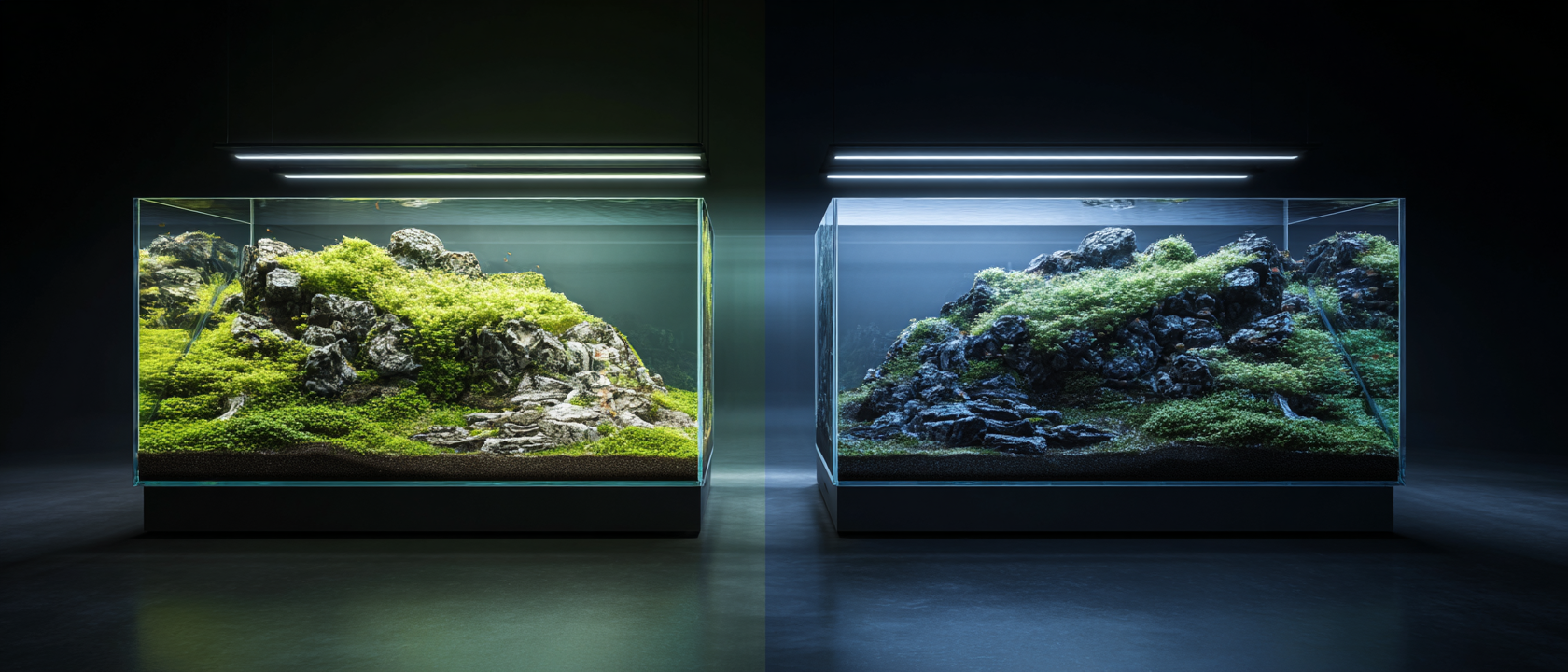
“Which aquarium should I buy?” It would be easy to reply with a number of litres. First, though, think about what you want to keep, where it will stand and the space and time you have for care. Those answers make the choice more useful. A small tank is not automatically easy, and a large one is not automatically trouble-free.
Think of the whole system
An aquarium brings together animals, plants, microbial communities, filtration and water chemistry. Choosing it is therefore more than deciding which glass box looks attractive.
Start with livestock requirements
Adult size, behaviour, group requirements, territorial space and feeding all affect the setup. A single fish, a breeding pair and a community of the same species may need different arrangements. Avoid treating a species-independent minimum-volume table as a definitive suitability test.
Research the intended animals using reliable species-specific sources before committing to dimensions. Consider the floor area, swimming length and the equipment needed to maintain their conditions.
Volume matters, but it is not everything
For the same amount of waste added, a larger volume offers more dilution. That does not guarantee stable conditions if stocking and feeding rise with tank size. Appropriate maintenance remains necessary at every scale. Larger systems may offer more room for livestock and layout, but they also bring greater cost, weight and maintenance demands. Choose a size that you can support and care for reliably.
Dimensions can change the experience
A 60 × 30 × 35 cm tank and a 40 × 40 × 40 cm tank have similar gross volumes, but different footprints and swimming lengths. Neither shape is universally better; suitability depends on the animals and the planned layout. For aquascaping, front-to-back depth affects the room available for hardscape and visual perspective. Height influences how easily you can reach the substrate and how lighting must be selected. These factors belong in the decision alongside volume.
Height and maintenance access
A taller tank can be appealing, but it may be harder to reach the bottom. Lighting at substrate level depends on the fixture, water depth and layout. Do not treat one height range as ideal for every plant or setup.
Small, medium and large systems
Small aquariums
These can be economical and space-efficient. Their limited swimming space and water volume make appropriate stocking and consistent care especially important.
Medium aquariums
A moderate size can balance room, cost and access. It is still essential to select the footprint around the intended livestock rather than assuming a category label makes it suitable.
Large aquariums
More space can allow broader layout choices and larger groups where appropriate. Purchase cost, total weight and the effort of moving water should be planned before installation.
Plan filtration at the same time
Leave room for intakes, outlets and maintenance. Internal filters occupy display space; external canisters need hose routing and access outside the tank. Filter suitability depends on media capacity, circulation and the system's load.
Check the furniture and total weight
One litre of water weighs approximately one kilogram. Glass, substrate, hardscape and equipment add further weight. Use support designed for the aquarium and assess the full load rather than water alone.
Allow for future plans
Think about likely changes in livestock and layout, but do not oversize simply because you might want a different tank later. A setup that fits your current needs and maintenance capacity is a practical starting point.
Common mistakes
Buying the smallest tank on the assumption it will be easiest.
Choosing livestock only after purchasing the aquarium.
Comparing tanks by litres without looking at footprint.
Planning filtration and furniture support after installation.
Spending the whole budget on the tank and leaving too little for equipment.
Frequently asked questions
How many litres should a first tank hold?
There is no universal number. Start with the intended animals, space and budget, then choose dimensions and equipment that meet those needs.
Is a rectangular tank better than a cube?
A longer tank may provide useful swimming length, while other layouts may benefit from depth. Compare the intended use rather than assuming one shape always wins.
Is a fishbowl a suitable starting point?
A tank with room for appropriate equipment and maintenance generally offers a more manageable first fish setup. The animals' requirements remain the deciding factor.
Following this in your own tank
Before the shopping list, make a short plan for livestock, space, total budget and regular care. Choosing the tank around that plan can reduce later changes. Plans can evolve; reassess the system’s needs when adding animals or equipment.