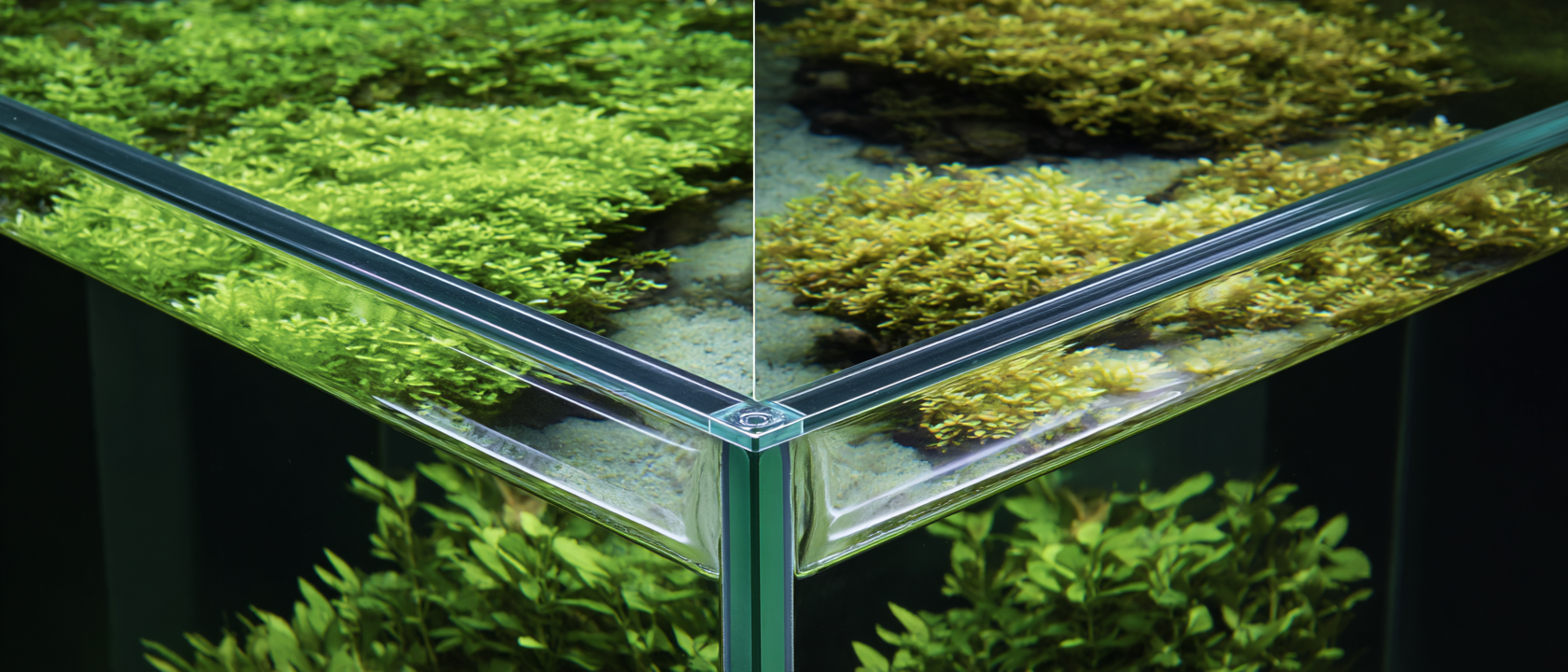
Two tanks side by side: one looks more neutral, while the edges of the other look greener. Iron content can explain part of that difference, but thickness, lighting and workmanship affect the view too. Before paying for an “extra clear” label, look at what you are comparing under the same conditions.
Why glass affects the view
The colour and optical properties of the panes can influence how plants, fish and pale hardscape appear. The visibility of edges and silicone also affects the overall impression, especially in an open-top layout.
Standard glass
Standard float glass commonly has a visible green tint, especially at its edges. That appearance is not, by itself, a structural defect. Standard glass is widely available and often more economical than low-iron alternatives. The visible effect depends on thickness, viewing angle and the colours behind the glass. A comparison made under different lighting may exaggerate or hide the difference.
Low-iron glass
Low-iron glass reduces the green colour associated with iron in conventional glass. It is often chosen where a neutral view of pale substrate, bright hardscape or plant colours is a priority. It does not automatically improve animal health, and optical clarity is not a substitute for suitable structural design. Compare technical data at the same thickness where available.
Extra clear and ultra clear
“Extra clear” and “ultra clear” can be commercial descriptions used by manufacturers. Do not assume the names establish a universal hierarchy. Compare the particular products' light transmission, colour and specifications rather than treating one label as automatically superior.
When is the difference most noticeable?
It may be easier to assess against pale materials or in side-by-side photographs made under the same conditions. Dark backgrounds and dense planting may make the difference less obvious. View samples if possible and decide whether the appearance justifies the cost for your setup.
Rimless aquariums
A rimless tank has no upper frame covering the pane edges. This exposes the glass and joints and can create a visually clean layout. The design also makes workmanship more visible. Open-top use can bring evaporation and splash-management considerations. A rimless label does not by itself determine whether a tank is well constructed or appropriate for the intended installation.
Mitred corners and silicone joints
Some tanks use angled glass edges to form mitred corners. These may produce a different visual appearance, but the angle alone does not establish structural safety. Suitable glass thickness, adhesive, joint design and manufacturing quality must be considered together. Consistent silicone lines and well-finished edges can improve appearance. A neat-looking seam alone does not prove structural adequacy. Our workmanship guide explains this distinction in more detail.
Common mistakes
Comparing only the tank's volume or price.
Assuming a clarity label describes structural quality.
Comparing glass samples of different thicknesses under different lighting.
Ignoring silicone joints and edge finishing.
Prioritising appearance over livestock space and suitable construction.
Frequently asked questions
Is low-iron glass essential?
No. It is an optical choice that may be worthwhile for a particular display. A correctly designed standard-glass aquarium can also be a suitable option.
Is clearer glass necessarily more fragile?
Clarity alone does not answer that question. Assess the particular glass specification and the aquarium's construction rather than inferring strength from colour.
Should I buy a tank labelled ultra clear?
Compare its actual specification with other options. The commercial name is not enough to establish the value of the upgrade.
Are mitred corners necessary?
No. They are one construction choice. Both appearance and structural design should be assessed for the particular tank.
Following this in your own tank
If possible, view glass samples at the same thickness under the same lighting. Then decide whether the difference is worth the cost for your display. Optical preference, suitable construction and livestock space are separate considerations; leave room for all of them.