

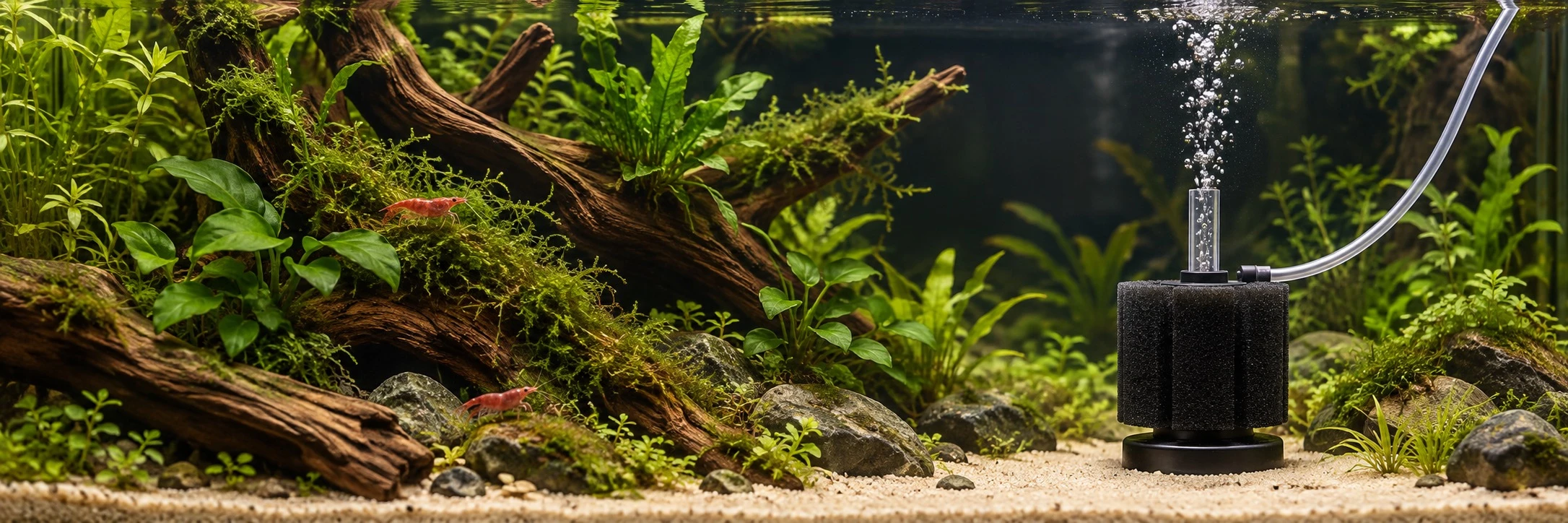
An air pump, a hose and some foam. Looking at a sponge filter, you might wonder whether something so simple can be enough. In a suitable setup it can be the main filter, or it can support another one. Here we look at the common air-driven designs. The useful question is how they fit the tank’s load and operating conditions, rather than how many bubbles you can see.
Will it be enough for my aquarium?
A suitably sized sponge filter can be a practical option for a fry or shrimp tank. It draws water through foam rather than an exposed intake that small animals might enter. Still, check that the foam fits properly and leaves no accessible gaps. If you keep many animals or feed heavily, do not decide by litres alone. Two tanks of the same volume can have different needs. Track ammonia and nitrite, debris accumulation and maintenance requirements to assess performance.
If your priorities include strong circulation, discreet equipment or using different filter media, compare internal and external filters too. Choose a sponge filter for the job you need it to do.
How does a sponge filter work?
An air pump sends air through tubing into the filter's uplift tube. Rising air carries water upwards, drawing surrounding water through the foam towards the tube. The air pump remains outside the aquarium. sera’s air-operated L filter range provides a manufacturer's explanation of this mechanism.
Visible bubbles are not a measurement of the water passing through the foam. A vigorous bubble stream does not prove that a filter can handle the stocking. Clogged foam, kinked tubing and connection problems can change how the system operates.
The foam does more than catch dirt
Foam traps some food crumbs and other small particles. It also gives microorganisms a place to live, helping keep the water suitable for your animals.
Animal waste and decaying food can produce ammonia, which can harm livestock. Microorganisms on the foam and other tank surfaces convert ammonia first into nitrite and then into nitrate. This process is called nitrification. Nitrite is harmful too, so completing the first step does not mean the aquarium is ready.
What this means for you: A brand-new sponge cannot do this job immediately. The microorganisms need time to become established. Do not assume a new tank is ready because the filter is running and the water looks clear; check ammonia and nitrite with water tests. Our Aquarium Filter Guide explains what different filters do.
When is it a practical choice?
Fry and shrimp aquariums
A filter that draws water through foam offers an alternative to exposed motor-driven intakes. Manufacturers also use this design for raising young fish. Nevertheless, inspect the particular model's openings, foam fit and current. A “shrimp filter” label is not an unconditional safety guarantee for every small animal.
Setups where maintenance access matters
Accessible foam can make regular maintenance straightforward. Packing the filter behind plants and hardscape reduces that advantage. When choosing a model, consider how you will remove it, rather than simply whether it fits inside the tank.
Supplementary filtration and backup planning
A sponge filter running alongside the main system can provide additional foam area. If you plan to move it to another tank, consider the source aquarium's health. Do not move foam from a tank with suspected disease: you could carry the problem into another aquarium. During a power cut, the air pump stops too. Plan separately for how you will keep the pump running.
Advantages and limitations
The foam may be visible and readily accessible, and the air-driven filter itself has no motor impeller. However, assessing the complete system also means considering the air pump, tubing and accessories. The appearance of the foam, space it occupies and sound of bubbles may matter in your installation.
If the goal is strong directional circulation or trapping very fine particles with specialised media, a simple sponge filter may not meet the entire requirement. Foam pores and filter designs differ. Decide which job you want the filter to perform rather than expecting it to cover every filtration task.
A sponge filter does not automatically collect all debris from the substrate or eliminate water changes. Accumulation in a distant corner does not always mean you need larger foam; placement and circulation deserve attention too.
What should you compare when buying?
Foam and access: Are replacement sponges available? Is removal straightforward? How much room remains in the tank?
Air-pump compatibility: Check the manufacturer's guidance for operating depth and the number of filters connected. Do not treat an air-flow rating as a water-flow rating.
Animal requirements: Inspect openings, foam fit and surface movement when keeping small animals.
Actual load: A heavily fed fry tank and a lightly fed shrimp tank should not be assessed using the same volume label alone.
The complete installation: Pump noise, tubing routes and maintenance access are part of the purchase decision.
Setup checks
Assemble the filter according to its own instructions. Confirm that the airline is connected to the correct fitting and is not pinched. Keep the air pump in a dry, safe position. If it operates below the water level, follow the manufacturer's protection guidance against back-siphoning; check a non-return valve's direction using the product marking. Aquarium Co-Op's air-pump guide explains these connections.
Position the filter without covering its foam surface with hardscape. Set the outlet height as directed in the manual. After starting it, examine the foam fit and circulation elsewhere in the aquarium as well as the bubbles. If several filters share a pump, observe the air distribution in each line separately.
How should you clean it?
Observe deposits and changes in operation rather than relying on one universal cleaning interval. During removal, try to contain trapped debris instead of releasing it into the tank. Gently clean the foam in water removed from the aquarium or appropriately dechlorinated water, without soap. Do not discard usable foam merely because it has darkened. Aquarium Co-Op's sponge-filter guide offers practical maintenance guidance.
Check the airline again after cleaning. Weaker bubbles may have a cause other than the foam: inspect tubing, the non-return valve, air distribution and any fitted air stone. Follow the pump and filter's safety instructions when checking components.
Common mistakes
Treating new foam as a mature biological filter: New equipment does not mean an established microorganism community.
Replacing every sponge at once: Removing debris and replacing all colonised media are different operations.
Using bubbles as a capacity rating: Assess stocking, measurements and maintenance needs together.
Switching the pump off each night: Switching off the pump stops water passing through the filter. If noise bothers you, check pump vibration, placement and the airline instead of stopping filtration every night.
Leaving no maintenance space: Equipment that is difficult to reach is difficult to maintain consistently.
Frequently asked questions
Can it be the only filter?
In an appropriate setup, yes. The volume on the box is not enough to decide. Consider how many animals you keep, how much you feed and your water-test results. If ammonia or nitrite appears, investigate it rather than relying on the filter’s tank-size label.
Is an air stone essential?
Not in every model. Some designs use an air stone and others distribute air differently. Follow your filter's instructions rather than forcing an incompatible component into it.
Is it better than a motor-driven internal filter?
There is no universal ranking. Intake safety, circulation, appearance and maintenance can carry different weight in different aquariums. Compare the alternatives in our Internal Filter Guide.
Does clear water mean the filter is sufficient?
Clarity alone does not tell you the ammonia or nitrite level. Water can look spotless while containing substances that harm livestock. Clear water does not replace a test.
Following this in your own tank
The simplicity of a sponge filter can be a useful advantage when it helps you maintain it consistently. Observe the foam, air line and animals, and keep readings alongside feeding and service dates. Visible bubbles alone cannot establish capacity, so use several indicators.
Related guides
Sources
sera internal filter L — manufacturer example of air-driven operation and use with fry.
Aquarium Co-Op: Sponge Filters — setup and maintenance.
Aquarium Co-Op: Aquarium Air Pumps — airlines and back-siphoning.
Oklahoma State University: Principles of Small-Scale Aquaponics — basic information about biological filtration and ammonia conversion.