

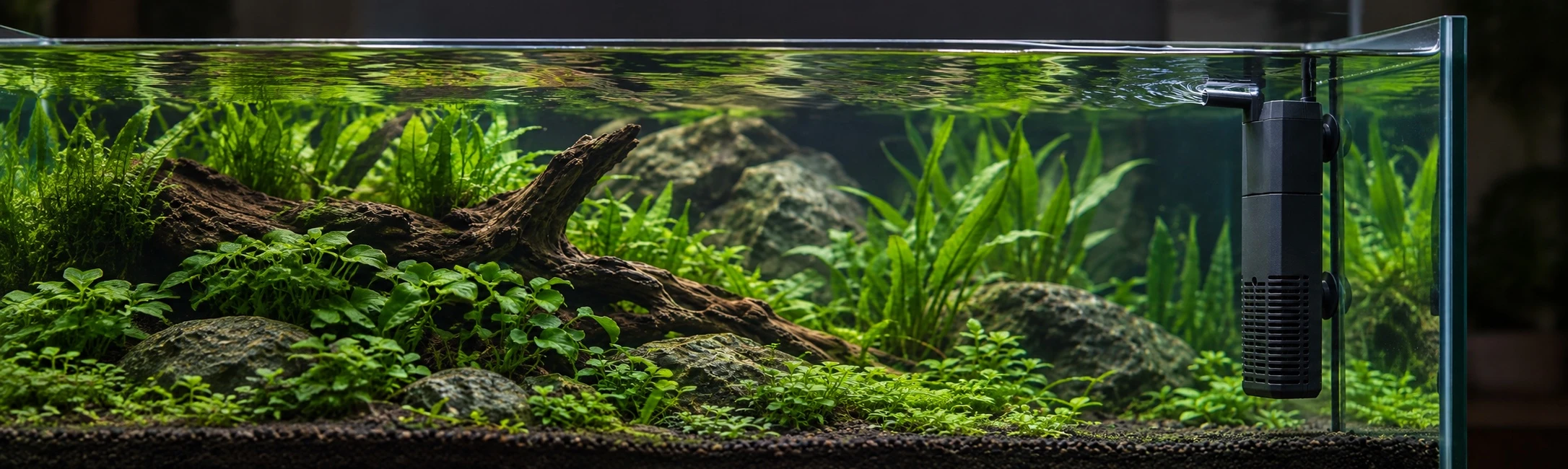
Considering an internal filter and wondering whether it is only for beginners? A suitable model can remain the main filter in a suitable tank. Keeping the pump and media inside can simplify installation, though it takes up display space. Look beyond the volume label to media space, intake safety and how you will maintain it.
How does an internal filter work?
In common motor-driven models, water enters through openings in the housing. It passes through foam or other filter media before the pump returns it to the aquarium. Flow paths differ between models. Follow the manufacturer's instructions for media order and the required water level.
The simplest models combine a motor and foam. Others include separate media baskets, adjustable flow, a directional outlet or a spray bar. Similar dimensions do not necessarily mean two filters offer the same media capacity or ease of maintenance. If you are unfamiliar with the basic functions of filtration, our What Is an Aquarium Filter? guide explains mechanical, biological and chemical filtration. This related guide is currently available in Turkish.
Foam does more than collect debris
Foam traps suspended particles, while its wet surfaces also provide space for microorganisms to colonise. The absence of a separate ceramic media basket does not mean a filter has no biological function.
Nitrification converts ammonia first into nitrite and then into nitrate. It takes place on other aquarium surfaces as well as in the filter. A filter supports the process by providing water flow and available surfaces. Switching on a new filter does not establish a mature biological system. Oklahoma State University explains the underlying process.
Water movement and air bubbles are different
An outlet that moves the surface can help gas exchange between water and air. Some filters use a venturi system to draw air into the water outlet. The number of visible bubbles does not, by itself, indicate the oxygen conditions in the tank.
A filter can move the surface without an air hose. An outlet positioned well below the surface, or a surface with little movement, may produce different results. If fish gather at the surface, assess temperature, water quality and other conditions rather than blaming the filter type alone.
Advantages of internal filters
Internal filters generally need neither external hoses nor a filter canister outside the tank. This simplifies installation where cabinet space is limited. Equipment may also be easy to reach in a compact setup, although some models must be removed entirely for cleaning.
A short, contained flow path reduces the number of external components to manage. Models with adjustable flow and directional outlets allow you to adapt circulation. The Tetra IN plus range illustrates these features; they should not be assumed to exist on every internal filter.
Supplementary filtration is another useful role. An accessible internal filter can help collect suspended debris alongside a main filter. Whether you need one depends on the actual system: adding more equipment does not automatically guarantee better water quality.
Disadvantages and limitations
An internal filter occupies tank space and may remain visible in the layout. Plants can soften its appearance, but they must not block the intake or prevent access for maintenance. In a small tank, the space taken up by the housing becomes more significant for swimming room and aquascaping.
Compact housings may offer limited media capacity. With heavy feeding or stocking, consider both the accumulation of particles and the filter's biological capacity. A stronger motor does not automatically turn a small media chamber into a larger biological filter.
Accumulated debris may spill into the tank during removal. Removable baskets, separate foam sections and access without emptying the entire housing can make maintenance easier. Before buying, examine how the filter opens and whether replacement foam is available, rather than comparing flow figures alone.
Which aquariums are suitable?
An internal filter can be the main filter where its capacity matches the stocking and equipment inside the tank is acceptable. The Fluval U Series description also discusses use as a primary filter in smaller aquariums and a supplementary filter in larger ones. This does not mean a particular model is sufficient for every tank.
For shrimp and fry, intake safety comes before motor power. Small animals may approach the openings or enter the filter. Inspect the design and use a well-fitting intake guard where appropriate. Guards can restrict flow as they collect debris, so check them regularly. Reducing flow alone should not be assumed to make an intake safe.
In a planted aquarium, consider the filter as part of the layout. Plants being pushed over near the outlet or debris collecting elsewhere may reflect uneven circulation rather than insufficient total flow. Outlet direction, hardscape and plant density all affect how water moves.
What should you check when choosing one?
Stocking and filter media
Two tanks of the same volume may have different filtration requirements. A lightly stocked tank with modest feeding and a breeding tank with intensive feeding should not be assessed using the same volume label. A manufacturer's suggested tank range is a starting point, not a replacement for considering operating conditions.
Inspect the usable media space. Can you remove the foam easily? Can sections be maintained separately? Are spare parts available? A filter that is awkward to maintain may cause practical problems despite impressive specifications.
Flow rate and circulation
Litres per hour describe a volume of water moved in an hour. The figure alone does not describe current throughout the tank, debris collection or biological capacity. Flow may change as media becomes dirty, while the outlet design affects the current experienced by animals.
Adjustable flow and outlet direction are useful. Aim for appropriate circulation rather than simply creating a powerful jet. The Filter Flow Guide on the NeoMa calculators page can provide an initial range; it is not a definitive test of filtration capacity.
Internal filters versus external canister filters
An internal filter houses its pump and media inside the aquarium. An external filter places the main canister outside. Many canister filters provide more media space, whereas internal filters require fewer external components. The decision should not be reduced to these two differences.
If visible equipment is undesirable, an external filter may be worth considering. Maintenance access, intake safety, budget and circulation requirements also matter. Our External Filter Guide, currently available in Turkish, explains that option's strengths and limitations. Replacing a small internal filter with any canister filter is not automatically an improvement.
How to assess placement in the tank
This guide uses “internal filter” to mean motor-driven submerged models. Air-driven sponge filters are a separate group. Check the required operating water level in the manual and never run the pump dry. Leave clearance between the intake and the substrate, glass or hardscape.
Position the outlet to create gentle surface movement where the model allows it. Look beyond the area immediately in front of the outlet and observe the opposite corner. Repeated debris accumulation or plants being pushed strongly in one direction may warrant reassessing circulation. Hiding behaviour alone is not proof of excessive current; consider other conditions as well.
For example, if flow is strong near the outlet but circulation is weak elsewhere, examine outlet direction and hardscape obstructions before buying a stronger filter. Assess the existing filter's maintenance needs before adding a second unit. Observe circulation and animal behaviour again after adjustments to see whether they helped.
Common installation and maintenance mistakes
Blocking the intake: Hiding a filter tightly behind hardscape or allowing plants to cover the intake can restrict water entry. Leave room for both circulation and removal. Replacing all media at every cleaning: Removing mechanical debris and discarding colonised media are different actions. Do not replace usable foam simply because it has turned brown. For models with multiple sections, follow the manufacturer's maintenance guidance.
Relying on a fixed cleaning schedule: No single interval suits every aquarium. Check for reduced flow, intake deposits and the condition of the foam. If flow drops, inspect the outlet and impeller area as well as the media.
Skipping safe maintenance steps: Follow the manual's electrical safety instructions before dismantling or cleaning. Aquarium water or appropriately dechlorinated water can be used for biological media cleaning. Do not use soap or detergent, and do not let the media dry. After reassembly, check that flow has returned.
Frequently asked questions
Can an internal filter be the only filter?
Yes. A suitably sized and properly maintained unit can serve as the main filter. Assess performance through stocking, ammonia and nitrite testing, and maintenance needs rather than water clarity alone. A new filter still needs biological maturation.
Should I turn it off at night?
Routine overnight shutdown is not recommended. Continuous filtration and circulation matter. If noise is a problem, investigate attachment, trapped air, the impeller and wear instead of switching the device off each night. Follow the manual when dismantling it.
Does it replace water changes?
No. Trapping particles or converting ammonia does not remove every dissolved substance. Assess water changes according to the tank's load, measurements and maintenance plan.
Is the air hose essential?
Not in every model or setup. Where a venturi is fitted, its use depends on tank requirements and the manufacturer's instructions. Removing the hose does not automatically cause oxygen deficiency; fitting it does not guarantee adequate oxygen.
Following this in your own tank
When choosing an internal filter, also consider how easily you can remove and clean it. A sustainable routine for checking the foam, intake and outlet can make long-term care easier. If something changes, consider feeding, temperature and recent maintenance alongside the filter.
Related guides
The following related guides are currently available in Turkish:
Sources
EHEIM aquaball instructions — installation, flow adjustment and safe maintenance.
Tetra IN plus technical description — separate filter sections and outlet adjustment.
Fluval U Series description — primary and supplementary filtration.
Oklahoma State University: Principles of Small-Scale Aquaponics — the underlying nitrification process, not numerical stocking advice for home aquariums.