

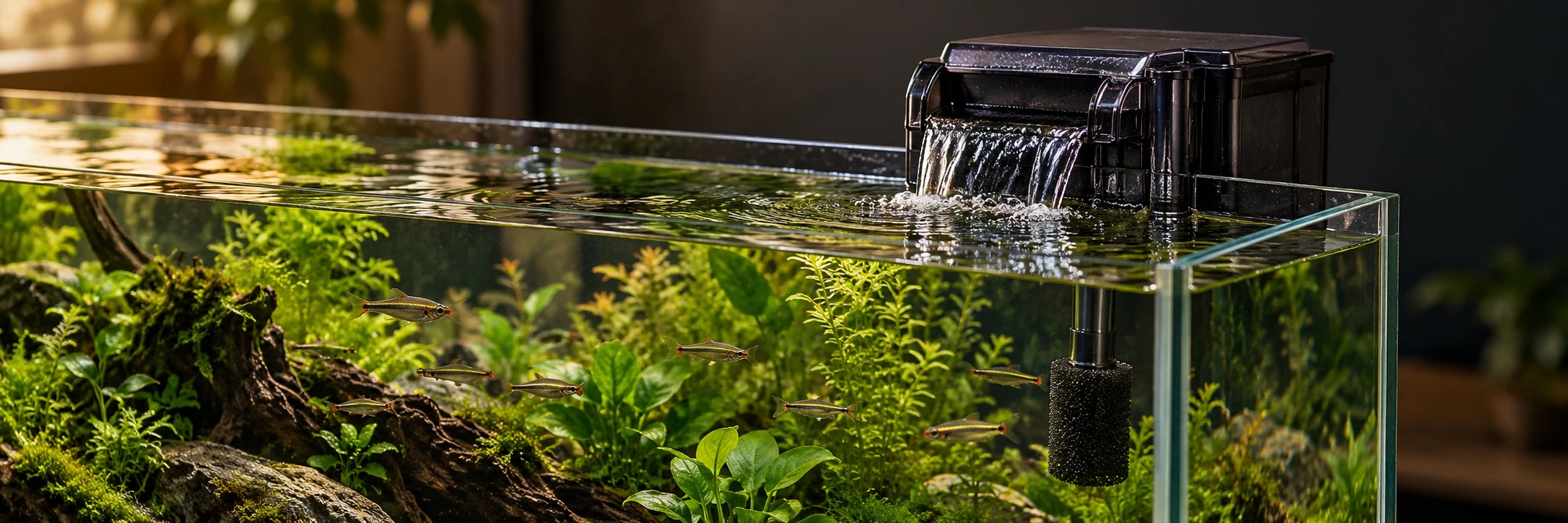
No room for a canister in the cabinet, and you would prefer less equipment inside the display? A hang-on-back filter is one option to consider. It hangs on the rim and returns water through an upper outlet. Before ordering, check a few easily overlooked details: the glass, lid and space behind the tank.
How does water pass through it?
An intake draws water into the filter chamber. Water passes through its media and returns through the outlet. Depending on the model, the chamber can hold foam, biological media and other materials. Follow its manual: the basket position does not tell you the actual flow direction.
The waterfall describes how water returns, not its filtration capacity. Media space, maintenance and operating conditions matter more than appearance. A tank-size label alone does not prove suitability.
Four checks before buying
First check physical fit. A thick rim, a narrow lid opening or a wall directly behind the aquarium can prevent mounting. Next inspect the intake for openings accessible to shrimp or fry. A compatible guard may help, but needs maintenance as debris can restrict flow.
Third, look at usable chamber space and access to media. Does it depend entirely on disposable cartridges? Finally, consider adjustment and noise. Lower water levels can change the distance water falls and the sound it makes. Pump noise and falling-water noise are separate concerns.
Starting it and handling power cuts
Mount the unit as directed. If the chamber needs filling before startup, do not skip that step or run the motor dry. Keep water level and intake position within the manufacturer’s requirements. Check the installation and that returning water stays safely inside the tank.
Do not assume every HOB will restart automatically after a power cut. Read the restart instructions and check operation when power returns. A method suitable for one model may not work for another.
What needs maintenance?
A weaker return does not automatically call for a larger filter. Following the model’s safe service instructions, inspect the intake guard, foam and impeller area for buildup. Focus on removing flow-restricting debris rather than making the foam look new. Check the basket fit afterwards too: water bypassing the media can make operation misleading.
As with other filters, new media is not mature biological filtration. Check ammonia and nitrite in a new setup instead of assuming clear water means it is ready for additional livestock.
Quick answers and NeoMa’s recommendation
Does a HOB replace water changes? No. Capturing particles does not remove every dissolved substance. Can it be used with shrimp? Potentially, with appropriate intake protection and current; inspect the actual design rather than relying on the label.
Example: choosing for a covered tank
For a covered aquarium, find out the filter dimensions and required clearance before modifying the lid. Consider lid opening, lighting and cables too. If there is no rear space, another filter type may be simpler. Keep measurements with a tank photograph when comparing products.
Frequently asked questions
Is waterfall noise always loud?
Water level, outlet design and installation affect sound. Compare reviews with your actual setup.
Can it replace a canister?
Potentially in a suitable system. Compare capacity, stocking and maintenance rather than names. For the basic jobs of filtration, see our Aquarium Filter Guide.
What should you record in NeoMa?
Record water level, filter model, intake protection and cleaning date. Note which change preceded noise or weak output. An installation photograph helps you compare clearances and connections later.
How can you tell it helped?
After adjustment or maintenance, check steady return, leaks and noise. Confirm operation after a power interruption. If the problem soon returns, reassess water level and the source of blockage.
Following this in your own tank
After installation, keep a photo and an observation of operation at the normal water level. They give you a reference for later noise or flow changes. Make checks after maintenance and power interruptions part of the routine so a stopped water return is easier to notice.