Necessary cookies keep the site working. With your permission we also load analytics (Google Analytics, Microsoft Clarity) and advertising (Google AdSense). Declining does not limit the guides or your account.
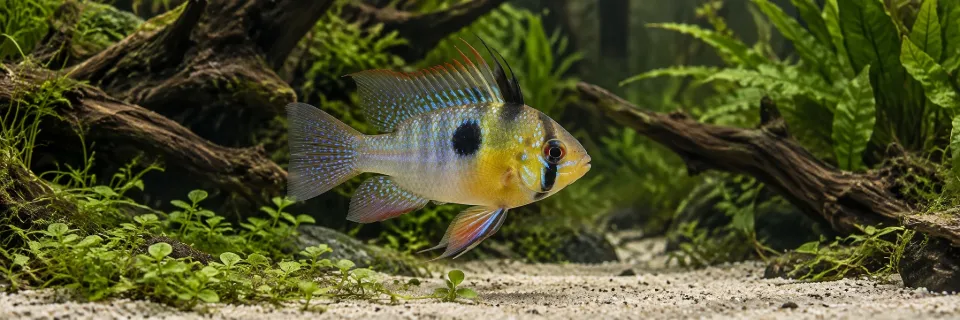
The ram cichlid may be small, but it has a distinct personality. In a planted aquarium, its colours and behaviour can make it one of the most noticeable fish in the tank.
One common mistake is to think of it simply as a small, peaceful community fish. A ram is still a cichlid. Once a pair forms, it may defend a territory, drive other fish away during spawning, or put considerable pressure on an incompatible partner.
A successful ram aquarium therefore depends on suitable water conditions, a thoughtful layout, compatible pairing and the right tank mates.
What Is a Ram Cichlid Like?
The ram’s scientific name is Mikrogeophagus ramirezi. It belongs to the family Cichlidae and originates from South America. Adults in aquariums commonly reach approximately 5–7 cm in total length.
Much of their behaviour centres on the lower part of the aquarium. They forage along the substrate, occupy particular areas and may defend a chosen site during breeding.
This is why aquarium volume tells only part of the story. A ram also needs usable bottom space and a layout that allows it to move, forage and retreat.
These are colour or body forms of Mikrogeophagus ramirezi. Some selectively bred forms can present concerns involving health, swimming ability or reproductive performance. A higher price or a more striking appearance does not necessarily indicate a healthier fish.
The Bolivian Ram is different. Mikrogeophagus altispinosus is a separate species, and its care requirements should not be treated as identical to those of M. ramirezi.
Where Do Rams Live in the Wild?
Rams are known from the Llanos region of the Orinoco River basin in Venezuela and Colombia. This region includes warm, seasonally flooded plains and a variety of freshwater habitats.
Their association with the bottom makes fine sandy areas and places offering shelter useful features to consider in an aquarium.
You do not need to recreate every detail of their natural habitat. A practical layout can provide:
Fine substrate without sharp edges.
Open areas for foraging.
Driftwood and plants that break lines of sight.
Quiet, sheltered areas.
Suitable flat surfaces for spawning.
The layout should give the fish somewhere to feel secure and room to express its normal behaviour.
What Size Aquarium Do Rams Need?
For a compatible pair of ram cichlids, a 40–50-litre aquarium with adequate floor space can be a suitable starting point.
However, volume alone is not enough. Horizontal swimming space, hiding places, visual barriers and the pair’s behaviour towards each other should also be considered.
This volume recommendation primarily applies to biologically mature, regularly maintained aquariums housing just one pair. Community aquariums, incompatible pairs or systems with more livestock may require more space.
What Water Conditions Do Rams Need?
Rams need warm, clean and stable water. Species references commonly describe the following conditions:
Parameter — Care considerations
Temperature: Generally 27–30 °C
pH: Natural habitats are often acidic; species references describe approximately pH 4.0–7.0
Hardness: Soft water is preferred
Ammonia: Harmful accumulation must be avoided
Nitrite: Should remain undetectable with an appropriate aquarium test
These values are not a single rigid prescription for every fish. For captive-bred rams, the conditions in which they were raised also matter.
Chasing a particular pH number can cause problems. pH, KH and GH describe different aspects of water chemistry. Changing pH rapidly to reach an “ideal” figure found online may do more harm than good.
At the same time, stability does not make unsuitable conditions safe. Very hard or distinctly alkaline water can still present challenges for long-term care and breeding.
A biologically established aquarium is another important requirement. Clear water does not prove that a tank is ready. Before adding rams to a new aquarium, the nitrogen cycle should be established and biological filtration capable of handling the existing livestock load.
Warm water holds less dissolved oxygen than cooler water under otherwise comparable conditions. Adequate surface movement and oxygenation become especially important at higher temperatures.
Can Rams Live in a Planted Aquarium?
Yes. A thoughtfully arranged planted aquarium can provide a suitable setting for their natural behaviour.
Driftwood, rocks and plants create visual barriers. Plants such as Anubias and Java fern can provide shaded areas around the hardscape.
The entire aquarium does not need to be densely planted. Leave open patches where the rams can forage along the substrate and move comfortably.
A useful layout balances open space, shelter and breaks in the line of sight. Those features matter as much as the appearance of the aquascape.
What Fish Can Live With Rams?
Rams can live with some peaceful species. Compatibility depends on more than whether a fish is labelled peaceful or aggressive: temperature, swimming level, competition for food, water conditions and breeding behaviour all influence the outcome.
Potentially Compatible Species
Cardinal Tetras
Cardinal tetras are schooling fish suited to warm, soft-water conditions. They can be considered for sufficiently spacious ram aquariums, but they should not be assumed safe around eggs or fry.
Green Neon Tetras
Paracheirodon simulans is another small schooling species to consider for warm, soft-water setups. Predation remains a consideration for very small individuals and fry.
Beckford’s Pencilfish
Nannostomus beckfordi may be suitable in appropriately arranged ram aquariums. Temperature compatibility, aquarium size and the fish’s behaviour still matter.
Harlequin Rasboras
Harlequin rasboras can coexist with rams in some community tanks. However, the higher temperatures preferred by rams may not align well with the rasboras’ long-term needs.
A fish tolerating 28–30 °C briefly does not establish that it will thrive at that temperature for years.
Which Tank Mates Need More Caution?
Corydoras Species
Bottom-dwelling fish may enter the area defended by a breeding pair. Not all Corydoras species suit the warmer conditions required by rams. Short-term heat tolerance is not a sound basis for pairing rams with species that prefer cooler water.
Other Dwarf Cichlids
Fish such as Apistogramma may compete for the same bottom space. Territorial conflict becomes more likely when the tank lacks room and visual barriers.
Shrimp
Adult shrimp may survive in some setups, but baby shrimp should not be considered safe. A ram’s small size does not remove its potential to prey on them.
Highly Active or Aggressive Fish
Fast feeders, fin nippers and territorial fish can interfere with the rams’ feeding and behaviour.
There is also an important distinction between living together in a community tank and successfully raising fry in that same tank.
How Can You Tell Male and Female Rams Apart?
Physical features can help distinguish the sexes, particularly in mature fish with classic coloration.
AI-generated illustrative comparison, not photographs of sex-confirmed individuals. Pink abdominal colour and fin development are supporting clues to assess together; no single trait proves sex.
Females often show a pink tint on the abdomen. This may become more noticeable during breeding.
Males commonly have a larger body and more pronounced extensions to some fins.
Blue spangling within the dark flank spot is also used as a supporting clue in classic-coloured rams. It is not a definitive test on its own. Young fish are especially difficult to sex, and forms such as Gold and Electric Blue may not display the usual colour clues clearly.
The female’s pink abdomen has also been studied scientifically. Research published by LaPlante and Delaney in 2020 found that male rams showed greater interest in images of females displaying pink abdominal coloration. This supports a role for the colour in mate choice; it does not mean that every individual can be reliably sexed from that feature alone.
Choosing two attractive fish from a shop and calling them a male and female does not necessarily mean you have selected a compatible pair.
How Can You Tell Whether Two Rams Have Formed a Pair?
Behaviour becomes more informative than appearance here. A compatible pair may share an area, move around together and begin showing interest in a particular surface or territory before spawning.
Brief chasing and sustained harassment are different situations.
If one fish continually hides, cannot reach food, is trapped in a corner or develops fin damage, do not assume that the fish are simply pairing up and will eventually settle down. Separation may be necessary.
What Should You Feed Rams?
Rams feed close to the substrate. In the wild, they may consume small invertebrates and other edible organisms found near the bottom.
In an aquarium, an appropriately sized, nutritionally balanced staple food provides a useful foundation. Small sinking pellets can suit many individuals.
Artemia, Daphnia and other suitably sized live or frozen foods from reliable sources can add variety. Live foods may introduce hygiene or parasite risks, and frozen foods need proper storage.
What matters is whether every fish actually gets to eat. A dominant partner may keep the other ram away from food.
Finding out what a new fish already accepts at the breeder or shop can make the transition easier. If food remains uneaten, adjust the portion and feeding routine rather than leaving it to accumulate.
How Do Rams Breed?
Under suitable conditions, rams may lay eggs on a flat stone, a broad leaf or another clean surface. They can also display parental care.
A separate, biologically established breeding tank can make it easier to provide quiet surroundings and manage water conditions. Successful breeding involves more than obtaining eggs: the eggs must develop, and the fry need suitable food once they become free-swimming.
1. Preparing the Pair
A compatible pair benefits from a balanced, varied diet, good water quality and low stress.
The fish need shelter, suitable spawning surfaces and an environment where they are not continually chased.
2. Spawning Behaviour
Before spawning, the pair may clean a stone or another surface. The female deposits eggs, which the male fertilises.
The parents may then defend the area and tend the eggs. Staying together or producing eggs does not guarantee that a pair will successfully raise fry under every set of conditions.
3. Egg Development
At suitable temperatures and under appropriate water conditions, eggs may hatch within a few days. The rate of development varies with temperature and other conditions.
Newly hatched larvae do not immediately begin swimming freely. They initially rely on nutrients in their yolk sacs.
At this stage, the fry’s actual development is more useful than following a fixed number of days on a calendar.
4. Free Swimming and First Foods
Once the fry become free-swimming, they need food small enough to eat.
Infusoria, suitable microworm cultures and, depending on the fry’s size, newly hatched Artemia nauplii may be options. First foods should match the fry’s mouth size and stage of development.
Do not assume that every fry can eat newly hatched Artemia from its first day of free swimming.
Insufficient food can cause losses, but so can deteriorating water quality from overfeeding.
5. Parents Eating the Eggs
Inexperienced pairs may eat their eggs or stop caring for them. There is no single explanation for this behaviour.
Stress, disturbance, eggs failing to develop and differences in parental behaviour may all play a part.
Abruptly changing water chemistry or repeatedly disturbing the fish after each unsuccessful spawning attempt can add further problems. Successful breeding depends on the pair’s behaviour and a consistent care routine as well as suitable water conditions.
What If a Ram Stops Eating?
A loss of appetite does not identify a particular disease. The timing and circumstances can help explain what is happening:
What has changed in the aquarium recently?
Have new fish been added?
Was there a water change?
Did the temperature change suddenly?
Is the other ram keeping it away from food?
Are ammonia or nitrite detectable?
Is the fish breathing rapidly?
Have its faeces, body condition or swimming behaviour changed?
Sometimes the problem is water quality. In other cases, it is social pressure or a newly introduced fish adjusting to its surroundings.
Investigate the cause before reaching for medication. Obvious breathing difficulty or rapid deterioration calls for prompt attention to water quality and oxygenation.
What Should You Look for When Buying Rams?
In the sales tank, watch how the fish breathe, swim and respond to food. Body condition matters too.
A fish that remains in a corner, looks noticeably thin, holds its fins clamped or breathes rapidly deserves closer attention. Bright colours alone are not a reliable reason to choose it.
Ask about the temperature and water conditions in which the fish have been kept, and which foods they accept.
Appropriate quarantine and observation before introducing new fish to an established aquarium can reduce the risk of bringing in disease.
Common Mistakes When Keeping Rams
One of the most common mistakes is choosing a setup based on the fish’s small size. A small fish does not necessarily do well in a very small aquarium.
Similarly, taking two fish at random from a shop does not establish a compatible pair.
Adding rams to an immature aquarium, repeatedly changing water parameters, crowding the bottom with other territorial fish and overlooking persistent harassment can all make their care more difficult.
Temperature compatibility is another frequent oversight when choosing tank mates.
Rams do not have to be difficult fish, but they do need a warm, clean and stable system.
NeoMa’s Practical Advice
Water readings tell only part of a ram’s story. Behaviour matters too.
The date a fish entered the aquarium, the first food it accepted, changes between a pair and photographs taken from the same angle can become useful records over time. A few weeks later, it is surprisingly easy to forget whether a fish has always behaved or looked a certain way.
NeoMa’s Tank Log can help you keep those observations together. You can record feeding responses, behaviour and maintenance notes from the beginning.
Bringing It All Together
Under suitable conditions, rams can be striking inhabitants of planted aquariums.
Three things deserve particular attention: appropriate and stable water conditions, a suitable living space and an understanding of the fish’s behaviour.
Choose tank mates for more than their size. Do not assume that two differently coloured fish form a pair. Give aquarium dimensions and layout as much thought as volume.
Understanding how rams use their environment makes it easier to maintain a setup that works for both the fish and their keeper.