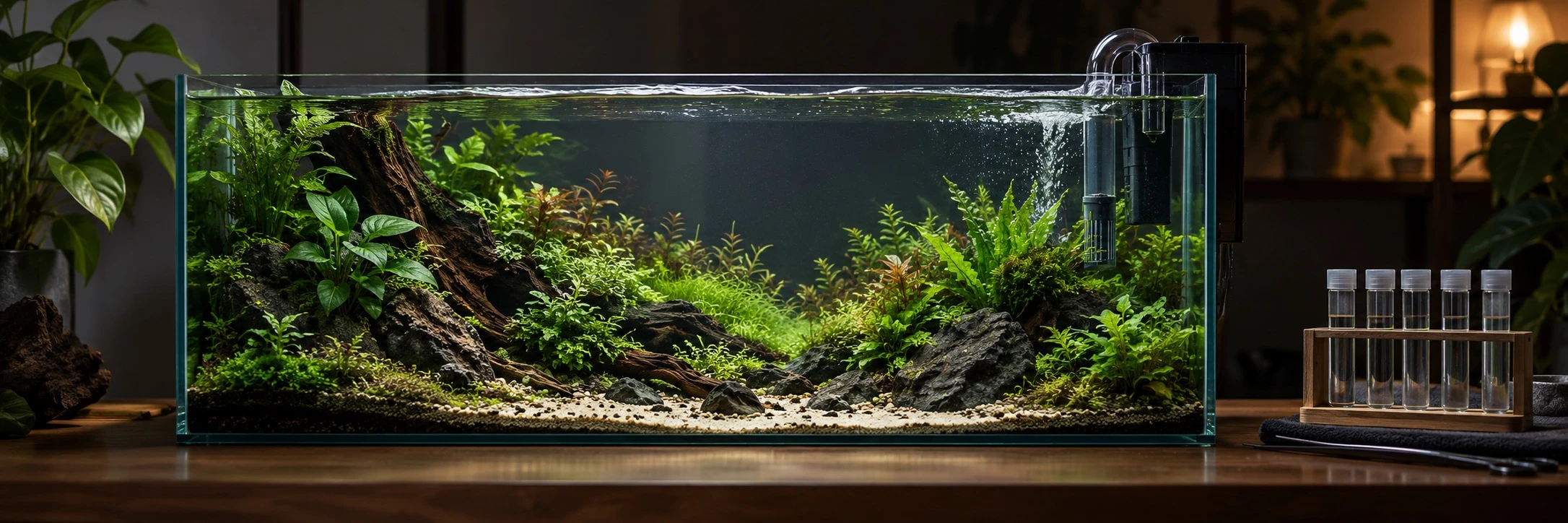
The tank is set up, the filter is running and the water looks good. It is understandable to want to add the animals. That view does not yet tell you whether the system can process their waste. Following the nitrogen cycle helps answer that question. Alongside counting days, follow what the water tests show over time.
How ammonia, nitrite and nitrate connect
Waste and decaying material can produce ammonia. Microorganisms convert it to nitrite and then nitrate. Ammonia and nitrite can harm livestock. Finding nitrate does not prove the first two are absent; their tests are not interchangeable. Colonised media and other wet surfaces matter, not just organisms floating in the water. Adding new ceramic media is not equivalent to obtaining an established biological system.
Why prepare without fish?
Fishless preparation avoids exposing animals to ammonia and nitrite while the system develops. Use a controlled, aquarium-appropriate input and follow its instructions. Do not use cleaning ammonia or unidentified chemicals. Zero readings in an empty aquarium are not enough if no waste input has been present. The important question is how the system processes the supplied load.
What should you follow instead of a calendar?
Alongside “How many days has it been?”, ask how the supplied load is being processed. Keep the ammonia source and ammonia and nitrite readings together. Follow your test’s shaking, waiting and reading instructions too. Reading a colour in unsuitable light or at the wrong time can give false reassurance or unnecessary alarm.
If animals are already present
If animals are present and ammonia or nitrite appears, do not avoid intervention merely to protect the cycle. Check testing, stop adding livestock, remove excess food and decaying material, and assess breathing and filter operation. Use appropriately prepared partial water changes when needed, then retest.
Seek experienced aquarium support if animals deteriorate. A bottled bacterial product does not replace monitoring and maintenance.
Common misunderstandings
Cloudiness does not confirm completion, and clarity offers no guarantee either. Old water is not equivalent to suitable established media. Material from an unhealthy tank can introduce other problems.
Example: zero readings do not always mean ready
Testing an empty aquarium without livestock or a controlled input gives zero. That may describe what is present now, but does not show that future waste will be processed. Understand how your preparation method verifies capacity. Do not add all planned animals merely because an unchallenged tank tests zero.
Frequently asked questions
Is it ready the day after adding bacteria?
Product use is not a timing guarantee. Verify using the preparation method and tests.
Can an established cycle never have problems?
Filter interruption, media work and changing load can affect processing. Monitor after changes. For the basic jobs of filtration, see our Aquarium Filter Guide.
What should you record in NeoMa?
Record setup date, preparation method, supplied input and measurements. Include units, timing, interruptions and whether livestock are present; empty-tank readings need that context.
How can you tell it helped?
Follow the capacity-verification criteria of your preparation method. An unchallenged zero reading does not show processing. Continue testing after initial stocking and increase the load gradually.
Following this in your own tank
Keep the supplied ammonia source and readings together in the setup log. A zero result in an unloaded tank tells you something different from evidence that an added load was processed. Continue the observations after adding livestock so you can notice how the new load affects the system.