Necessary cookies keep the site working. With your permission we also load analytics (Google Analytics, Microsoft Clarity) and advertising (Google AdSense). Declining does not limit the guides or your account.
Gold Ram Care Guide: Male vs Female, Tank Size and Breeding
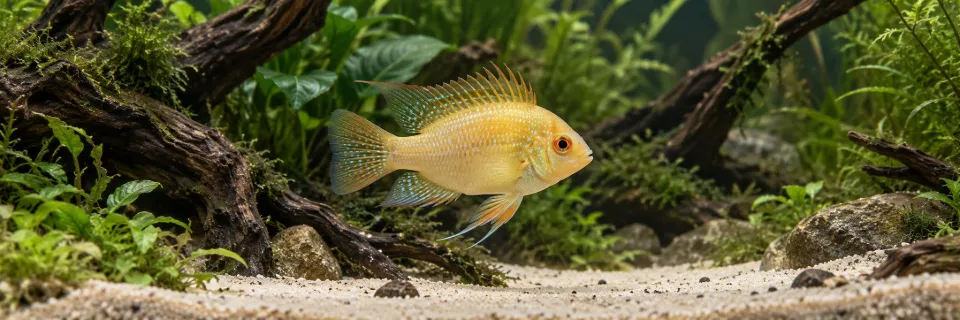
The Gold Ram is one of the most eye-catching color varieties of the German Blue Ram. Its golden-yellow body, occasional blue iridescence, and distinctive behavior make it particularly attractive in planted aquariums.
However, this color variety presents a small challenge: some of the visual characteristics commonly used to distinguish male and female German Blue Rams can be more difficult to identify in Gold Rams.
When choosing two Gold Rams at an aquarium store, determining their sex based solely on color, body size, or fin shape may not be as reliable as it seems.
Successful Gold Ram care begins with understanding the difference between the fish's appearance and its biological needs.
Is the Gold Ram a Separate Species?
No. The Gold Ram is a selectively bred color variety of Mikrogeophagus ramirezi.
Names such as German Blue, Gold, Electric Blue, and Black Ram refer to different color forms of the same species rather than separate species.
Therefore, Gold Rams do not require an entirely different aquarium setup or a special set of water parameters.
What has primarily changed is their appearance, not their fundamental biology.
For general care, tank size, water conditions, and compatible species, see our German Blue Ram Care Guide.
In this article, we'll focus on the characteristics that deserve particular attention in the Gold variety.
How Can You Tell Male and Female Gold Rams Apart?
One of the main reasons Gold Rams can be difficult to sex is their coloration.
AI-generated illustrative examples, not photographs of sex-confirmed individuals. Pink colour may be absent in Gold forms; colour and fin length alone do not prove sex.
In classic German Blue Rams, pink abdominal coloration is one of the characteristics commonly used to identify females. Dark body markings, body shape, and fin development may also be evaluated together.
In Gold Rams, however, the yellow-gold background can reduce the contrast of certain color markings.
If the dark lateral spot commonly observed in classic German Blue Rams is not clearly visible in a Gold individual, it cannot be used reliably for sex identification.
For this reason, sexing should involve several physical characteristics and behavioral observations rather than relying on a single feature.
Female Gold Ram
Mature females may display pink or pinkish coloration around the abdomen.
However, there is an important distinction: the absence of a visible pink belly does not prove that the fish is male.
Age, physical condition, lighting, and the color variety itself can influence how clearly this feature appears.
Females may also develop a fuller abdomen as spawning approaches.
However, abdominal fullness alone is not proof of sex or breeding readiness. Feeding and possible health conditions must also be considered.
Male Gold Ram
Mature males may be larger and develop more pronounced fins.
However, a simple rule such as "long fins always mean male" is not reliable.
Sex identification is especially uncertain in juvenile fish.
Size differences can also be misleading when the individuals being compared are not the same age.
Previously damaged or regenerating fins can make physical assessment even more difficult.
Therefore, examining two young Gold Rams for a few seconds at an aquarium store cannot realistically provide a 100% guarantee of their sexes.
What Is the Most Reliable Way to Sex Gold Rams?
The best approach is to evaluate several physical characteristics together in mature fish and observe reproductive behavior whenever possible.
Directly observing which individual deposits eggs during spawning provides much stronger evidence than estimating sex from color or fin shape.
However, two fish cleaning the same stone, swimming together, or remaining close to each other does not conclusively confirm their sexes.
These behaviors may be associated with pair formation, but they are not definitive proof.
How Do You Choose a Gold Ram Pair?
Whenever possible, pay attention to how the fish interact rather than focusing exclusively on their physical appearance.
Two fish swimming close together or spending time in the same area may be an encouraging sign.
However, this does not automatically mean they have formed a compatible pair.
A genuinely compatible pair should be able to share territory without constant conflict.
If one fish repeatedly chases the other, prevents it from eating, or forces it into a corner, the relationship may not be healthy.
Watch for warning signs such as:
One fish hiding constantly
Dominance preventing the other fish from feeding
Persistent and intense chasing
Damaged fins
One fish displaying clear signs of stress
If the aggression continues, separating the fish may be necessary.
When purchasing a pair described as having breeding experience, ask the seller:
"Have these fish actually spawned and produced fertilized eggs together, or are they simply believed to be a male and a female?"
In the aquarium trade, the word "pair" is sometimes used for two fish that have genuinely formed a breeding partnership and sometimes for two individuals merely believed to be of opposite sexes.
These are not the same thing.
Are Gold Rams More Sensitive Than German Blue Rams?
The Gold Ram's coloration does not automatically mean it is less healthy or less resilient than the classic German Blue Ram.
Selective breeding that emphasizes particular visual characteristics may, in some breeding populations, raise concerns about genetic diversity and undesirable inherited traits.
However, this general possibility does not demonstrate that every Gold Ram has the same health problems.
The breeding line, rearing conditions, transportation history, age, and physical condition of the individual fish all matter.
When choosing a healthy Gold Ram, prioritize behavior and physical condition over the intensity of its golden coloration.
What Temperature Do Gold Rams Need?
Gold Rams have essentially the same temperature and water requirements as classic German Blue Rams.
For general care, 27–30°C (81–86°F) is a useful planning range.
However, the conditions in which the fish was raised and the temperature requirements of other aquarium inhabitants should also be considered.
Soft, clean, stable water is generally preferred.
pH, general hardness (GH), and carbonate hardness (KH) should be evaluated together.
Making sudden chemical adjustments simply to reach a particular pH value is not recommended.
As water temperature increases, its capacity to hold dissolved oxygen decreases. Adequate surface movement and oxygenation are therefore important.
Do not introduce Gold Rams into an aquarium that has not established a functioning biological nitrogen cycle.
Preventing harmful ammonia and nitrite accumulation is essential for all Mikrogeophagus ramirezi varieties.
What Tank Size Do Gold Rams Need?
For a compatible pair of ram cichlids, a 40–50-litre aquarium with adequate floor space can be a suitable starting point.
However, volume alone is not enough. Horizontal swimming space, hiding places, visual barriers and the pair’s behaviour towards each other should also be considered.
This volume recommendation primarily applies to biologically mature, regularly maintained aquariums housing just one pair. Community aquariums, incompatible pairs or systems with more livestock may require more space.
Why Is My Gold Ram Losing Its Color?
One common mistake when choosing Gold Rams is treating color intensity as a direct indicator of health.
A fish that appears extremely bright yellow at the aquarium store is not automatically healthier.
Likewise, a fish that looks slightly different after being introduced into your aquarium is not necessarily experiencing a problem.
Start with a simple consideration: the lighting has changed.
The spectrum of the aquarium store's lighting may be very different from the lighting in your home aquarium.
The same fish can look noticeably different under different light sources.
Camera white balance and viewing angle can also influence how its color appears.
When evaluating a possible color change, look beyond the color itself.
Is the fish eating normally?
Is it swimming normally?
Has its breathing changed?
Is it holding its fins naturally?
Is another fish intimidating it?
Have aquarium conditions changed recently?
Are ammonia and nitrite readings within safe limits?
These observations are often more meaningful than asking whether the fish used to look slightly more yellow.
Color alone cannot diagnose a disease.
Should I Increase the Lighting to Make My Gold Ram Look More Yellow?
No.
Increasing aquarium lighting unnecessarily just to make a Gold Ram appear brighter is not a good husbandry strategy.
Lighting should primarily be adjusted according to the needs of the aquarium and its plants.
Increasing light intensity simply to enhance the fish's appearance may disrupt the balance between light, CO₂, and nutrients in a planted aquarium.
It may also reduce the shaded areas where the fish feels comfortable.
Similarly, overfeeding in an attempt to intensify coloration is not recommended.
Uneaten food increases the aquarium's organic waste load.
Physical condition comes before color intensity.
What Do Gold Rams Eat?
Gold Rams have essentially the same dietary requirements as classic German Blue Rams.
High-quality, appropriately sized microgranules or small sinking pellets can form part of their staple diet.
Suitable live or frozen foods, including Artemia and Daphnia from reliable sources, can provide additional variety.
The important consideration is not simply the type of food but whether the fish is actually eating.
A newly purchased Gold Ram may not immediately accept unfamiliar dry food.
Asking the seller what the fish was previously fed can make the transition easier.
Remember that live foods may carry hygiene risks, frozen foods require proper storage, and excessive feeding can negatively affect water quality.
Can Gold Rams Live in Planted Aquariums?
Yes.
Gold Rams are particularly attractive in planted aquariums and do not require a different planting arrangement from classic German Blue Rams.
Driftwood, roots, and plants can be used to create visual barriers, while open substrate areas can be left between hardscape elements.
If you are keeping a pair, design the aquarium not only for appearance but also to allow the fish to move away from each other when necessary.
Dense planting alone is not enough.
Rams should also have accessible bottom areas where they can move and forage comfortably.
Our main German Blue Ram guide covers aquarium layout in greater detail, so we will not repeat the entire setup process here.
What Fish Can Live With Gold Rams?
There is no reason to change your choice of tank mates solely because of the Gold coloration.
We choose tank mates for Gold Rams because they are Rams, not because they are gold.
Peaceful species that can thrive at compatible temperatures and do not constantly compete for bottom territories may be suitable.
Calm fish that primarily occupy the middle and upper water levels can be good candidates.
Cardinal Tetras and certain pencilfish species may be considered under appropriate conditions.
However, long-term temperature compatibility and aquarium dimensions must always be taken into account.
Other dwarf cichlids may compete for the same bottom territories.
Bottom-dwelling fish may also enter areas defended by a breeding pair.
Baby shrimp should not be considered safe from predation.
What Is the Difference Between Gold and Electric Blue Rams?
Both are color varieties of Mikrogeophagus ramirezi.
The primary difference is their appearance.
Gold Rams display predominantly golden-yellow coloration, while Electric Blue Rams have metallic blue coloration covering much more of the body.
In both varieties, selective breeding for coloration can make some of the traditional visual characteristics used for sex identification more difficult to interpret.
However, it would be incorrect to treat Gold and Electric Blue Rams as though they had entirely different biological requirements.
Their fundamental care needs are based on the same species.
Can Gold Rams Be Bred?
Yes.
Because Gold Rams belong to the same species as classic German Blue Rams, their fundamental reproductive biology is the same.
Compatible pairs may deposit eggs on suitable surfaces and display parental care.
However, laying eggs does not automatically mean breeding has been successful.
Fertilization, egg development, hatching, and feeding free-swimming fry are separate stages.
If you are purchasing Gold Rams for breeding, ask whether the pair has previously spawned successfully or raised fry.
Do not automatically choose the fish with the brightest coloration.
Observe the fish itself first.
Does it approach food when offered?
Does it swim normally and maintain its balance?
Is its breathing calm and regular?
Are there visible injuries or damaged fins?
Is it constantly being chased away by other Rams?
Is its abdomen excessively sunken?
Do other fish in the aquarium show signs of illness?
If possible, ask when the fish arrived at the store, what foods it accepts, and what water conditions it has been kept in.
An appropriate quarantine and observation period before introducing new fish into an established aquarium can also help reduce disease transmission risks.
After evaluating these factors, you can choose your preferred coloration and pattern.
Starting with a healthy, well-conditioned fish is far more valuable than choosing a brilliantly colored individual that refuses food.
NeoMa's Recommendation
Take a photograph of your Gold Ram on the first day.
Whenever possible, take subsequent photographs under similar lighting conditions and from similar angles.
This will allow you to compare changes in coloration, body condition, and development over time rather than relying entirely on memory.
A photographic history is especially useful for visually distinctive color varieties such as Gold Rams.
In the NeoMa Tank Journal, you can keep the fish's introduction date, first accepted food, and photographs together as part of your aquarium's history.
Conclusion
The most important difference in keeping Gold Rams is not necessarily how we care for them, but how we evaluate them.
Their golden-yellow coloration can make some of the traditional sexing characteristics used in classic German Blue Rams harder to identify.
Therefore:
Do not treat coloration as proof of sex.
Do not use color intensity as a standalone health test.
Do not disrupt aquarium conditions simply to change the fish's appearance.
Do not automatically assume two fish swimming together form a compatible breeding pair.
Do not attribute every breeding failure to the color variety.
Choose a healthy, compatible fish first.
The Gold Ram's beautiful coloration should never take priority over its health and well-being.