

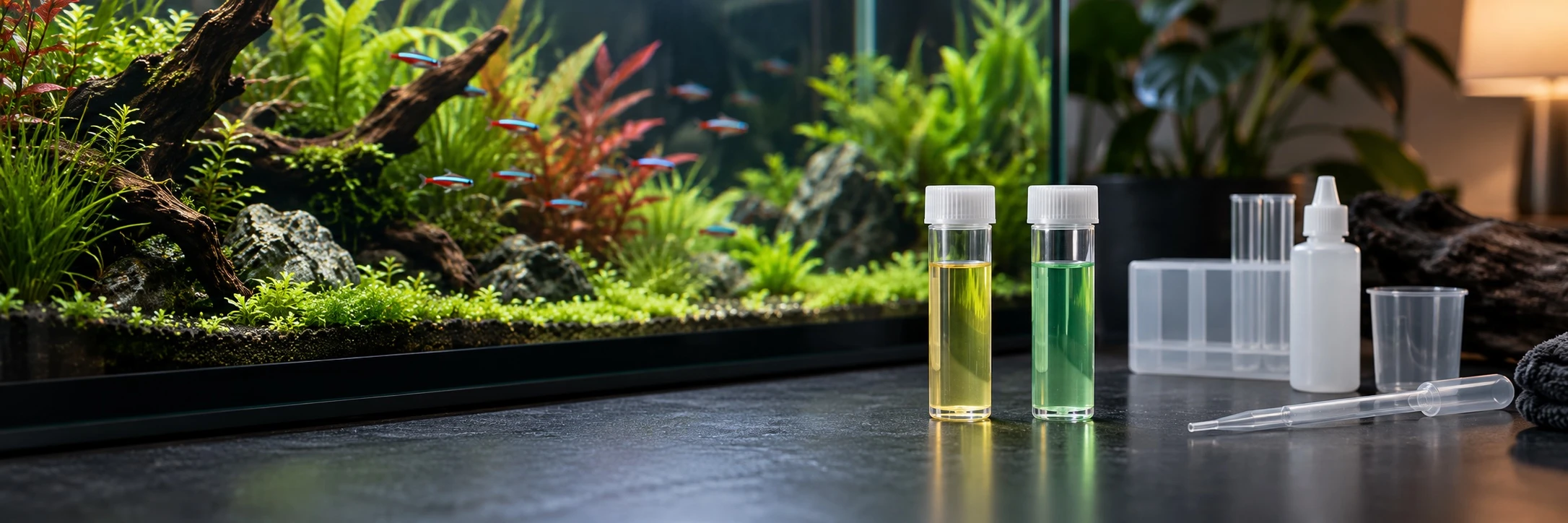
Ammonia in Your Aquarium: Reading the Result and Responding
The test tube changes colour, and the urge to clean everything or add several products arrives quickly. First, establish what the test measures and why the waste load may have changed. An ammonia problem can happen in an established aquarium as well as a new one.
This guide covers freshwater tanks. If fish are clearly struggling to breathe, improve aeration and stop injected CO₂. When a water-quality problem is suspected, make a partial change with suitably prepared water and test again. Do not wait for livestock to deteriorate while interpreting the result.
What does your ammonia kit actually measure?
Ammonia (NH₃) and ammonium (NH₄⁺) can both be present. Many kits measure their total; other methods report a different fraction. Look for terms such as total ammonia, TAN, NH₃/NH₄ or free ammonia on the instructions.
The same total reading does not represent the same risk at every pH and temperature. The proportion of the more toxic NH₃ can rise as pH and temperature increase. Record both alongside the result. A low pH is not permission to ignore the reading, and rapidly forcing pH down is not a sound ammonia response.
Keep the reported unit. A value expressed as nitrogen cannot be directly compared with one expressed as NH₃ or total NH₃/NH₄. A table found online may be misleading if its units and test method do not match yours.
Look back over the recent tank history
Have you added livestock, increased feeding or lost an animal? Has the filter stopped for a long period? Were all the media replaced? Was medication used recently? These are checks to investigate, not a list from which to pick one convenient diagnosis.
Leftover food after heavier feeding gives you a concrete reason to reduce that load. If the filter has also stopped, feeding less alone may not solve the situation. Our biological filtration guide explains waste processing, while the nitrogen cycle guide covers why a new system needs time and testing.
Reduce incoming waste and protect the filter
A brief feeding pause can reduce new waste for healthy adult fish. Do not automatically apply that advice to fry or livestock with specialised feeding needs. Remove accessible decaying food and dead animals without dismantling the aquarium.
Check that the filter works and that water can pass through it. Replacing all biological media may remove part of the capacity you need. Address an actual blockage using the approach in our filter cleaning guide; a positive test alone is not a reason to wash the whole filter.
Use a partial water change with properly prepared water of suitable temperature and chemistry. Let severity and measurements guide the amount, then check the result again. Test replacement water when needed. If readings repeatedly appear after changes, investigate the source water and its chlorine or chloramine preparation. Our water change guide covers the practical process.
Why is the test still positive after a conditioner?
Using a product does not automatically make the result incorrect or the livestock safe. Some products can affect readings with particular test methods. Check compatibility instructions for both the product and the kit, the required reading time, and the kit’s expiry date.
Record the product, dose and time used. Repeat the test correctly and, where necessary, confirm it using a compatible method. Do not dismiss animal behaviour or follow-up because someone says the test “always gives a false reading”. Stacking several products without knowing their roles is not a useful substitute for checking.
A falling ammonia result is only part of recovery
Keep monitoring nitrite too. One functioning step of the cycle does not establish that the whole system can process its current load. A useful record connects the reading before action, water changed, the subsequent reading and the next check.
Delay adding livestock. When feeding resumes, consider the animals’ needs, behaviour and the trend in results together. Returning immediately to the previous food load can recreate the problem if its cause remains. Persistent breathing distress, deaths or a situation that fails to improve calls for experienced aquatic-health support.
Two common questions
Can clear water contain ammonia? Yes. Clarity is not a chemical safety test. An attractive-looking tank can still need water testing.
Is adding bottled bacteria enough? An appropriate product may help under suitable conditions, but it does not by itself establish that ongoing waste, a stopped filter or unsuitable water has been addressed. Follow its instructions and assess the outcome with tests and animal behaviour.
Make the next reading useful
In your NeoMa tank journal, note pH, temperature, the test method and unit, feeding changes and filter maintenance alongside the result. This turns “the reading went up” into a traceable history.
Recovery is supported by readings that stay down and livestock returning to normal behaviour together. The long-term aim is a consistent observation and maintenance routine suited to the tank’s load, rather than an ever-growing collection of products.