

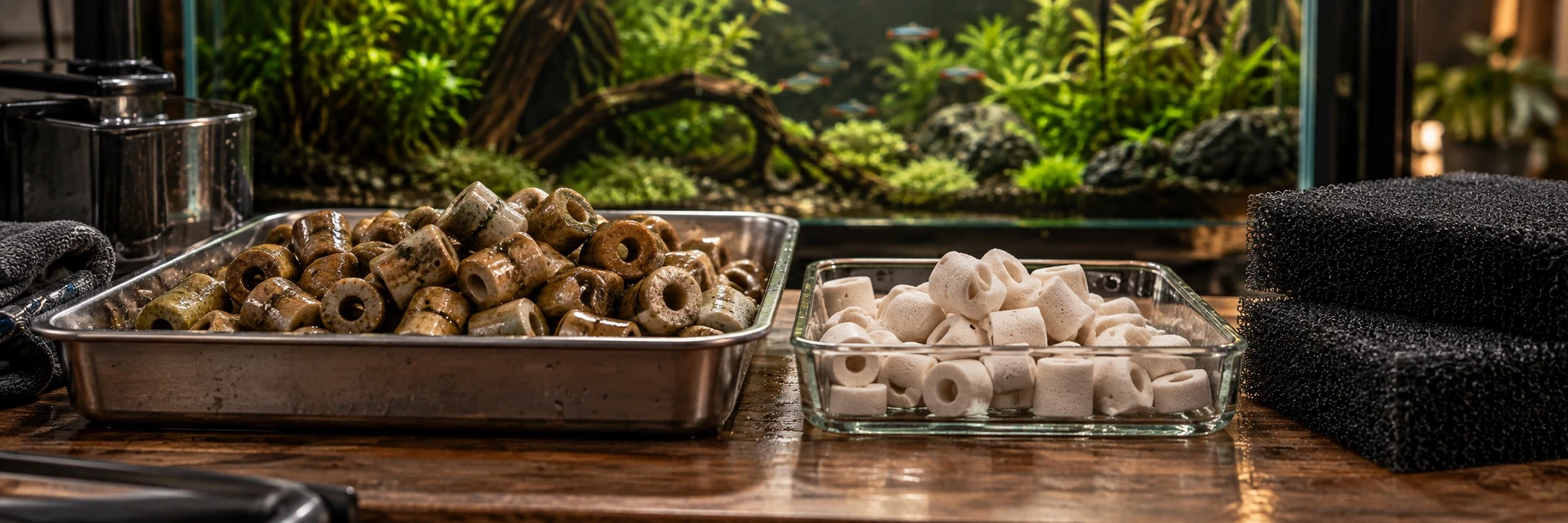
You open the filter and find brown foam and ceramic media that no longer look new. Replacing everything can feel like a fresh start. First, though, look at what has actually changed. Dirty foam may still be reusable, collapsing floss may need replacing, and carbon needs a different assessment. One replacement schedule can miss those differences.
Foam: inspect structure, not colour
Brown foam has not necessarily reached the end of its useful life. After cleaning, check its shape, fit and water passage. If those are suitable, it may still be reusable. Crumbling or permanently collapsed foam needs a different assessment. Separating colour from structural damage helps avoid discarding useful material.
Floss: the fine-particle stage
Floss can compact or break apart. Replacement may be appropriate if cleaning no longer restores passage or the material cannot be seated properly. Avoid cramming excessive fine material into a basket. If floss repeatedly blocks quickly, investigate the preceding mechanical stage, food leftovers and disturbed substrate instead of simply buying more.
Ceramic media: a calendar is not enough
Read the specific medium’s maintenance and replacement guidance. Neither unlimited life for every ceramic product nor frequent blanket replacement is a reliable rule. Consider wear, deposits, routing and the instructions. EHEIM advises against cleaning or replacing all media together for certain biological products. Do not copy a product-specific proportion or interval to every brand.
Carbon and resin: follow the intended job
Carbon and specialised resins have service requirements related to their intended substances and capacity. Colour may not reliably reveal exhaustion. Follow usage and replacement instructions; regeneration methods are not interchangeable. Do not assume chemical media must always be present. Define the purpose, such as a selected contaminant or a post-treatment step, before replacing it automatically.
How should replacement be planned?
Identify the material and reason for replacement, then choose a compatible fit. Where the design permits, preserve some usable established biological area during the transition. Avoid prolonged drying and cleaning chemicals. Check output and water measurements afterwards. Adding many animals or increasing feeding at the same time changes the load too; separate unnecessary simultaneous changes.
Example: separate cartridge decisions
A cartridge may combine mechanical and chemical functions. Identify those functions before deciding on replacement. Check compatible maintenance options rather than stuffing the chamber with arbitrary materials. Consider the biological surfaces affected and follow tests after the change.
Frequently asked questions
Should darkened ceramic be discarded?
Colour alone is not enough. Assess structure, deposits, routing and instructions.
Does adding new media allow more livestock?
New area is not instantly mature capacity. Monitor performance before increasing the load. For the basic jobs of filtration, see our Aquarium Filter Guide.
What should you record in NeoMa?
Record material, date and reason: wear, blockage or a specific service limit. For chemical media, note instructions and the substance it targets.
How can you tell it helped?
Check fit, restored flow and relevant measurements. Monitor ammonia and nitrite after biological-media changes. A new-looking part does not prove every filtration task is working.
Following this in your own tank
Base replacement on the material’s job and condition. Recording why you changed it gives you something to compare at the next service. Weak flow can also involve the intake or hoses, so avoid assuming that media replacement is the only answer.