Feeding Aquarium Fish: Look at the Tank After the Meal Too
The fish gather at the front glass when you pick up the food. It is tempting to add another pinch. But that response alone does not tell you how much they need. Check three things together: is the food appropriate, does every fish get access, and what remains afterwards? “How many times a day?” is only part of a useful feeding routine.
This guide covers everyday freshwater fish feeding. Raising fry, specialised diets and feeding during illness require separate consideration. Do not automatically give shrimp and snails the same feeding plan as the fish.
How often should aquarium fish be fed?
For many healthy adult aquarium fish, one or two small meals a day can be a starting point to evaluate against species needs and the food instructions. It is not a fixed schedule for every animal. Fry, growing fish and species with specialised feeding habits can need a different plan.
Increasing the number of meals need not automatically increase the daily total. Who feeds each meal? If two people feed the same fish independently, a sensible-looking schedule can conceal a much larger total. A shared record or prepared portions can reduce that confusion.
Read the fish's needs as well as the packet
Establish the full species identity, life stage and natural diet. Sharing an aquarium does not make the same menu suitable for an animal-based feeder and a primarily plant-based feeder. “Bottom fish” is not one dietary category either.
Read which animals the product is intended for and whether it is a complete or supplementary food. Variety belongs within a suitable overall diet, rather than a random new product every day. A protein percentage alone cannot identify the best food for every species.
Food entered the water, but did everyone eat?
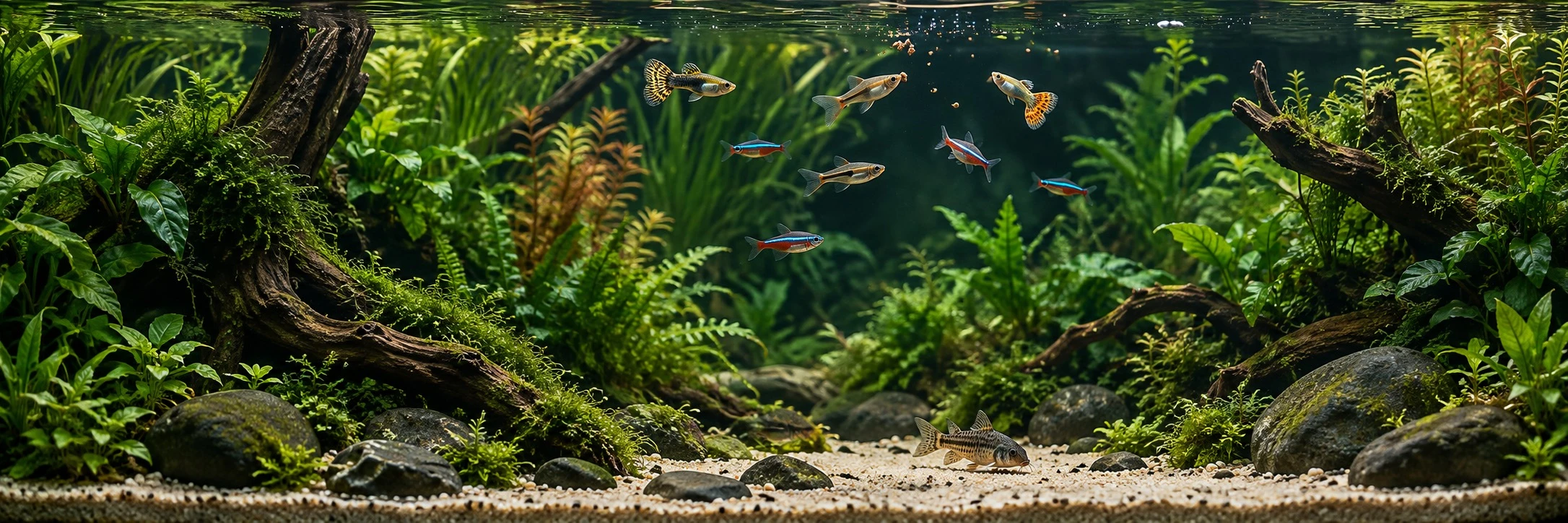
Particle size needs to suit the fish's ability to take it. Floating, slowly sinking and bottom-reaching foods offer different access. In a community aquarium, watch whether shy animals and bottom feeders actually eat while faster fish take the food.
You may need to change the feeding location, time or appropriate food form. Adding more food throughout the tank may not solve the access problem. If one fish repeatedly misses meals, consider compatibility and competition as well as the portion. Do not leave bottom dwellers unfed on the assumption that leftovers provide their diet.
Start with a small, repeatable portion
A clean, dry measure is easier to repeat than a different-sized pinch each day. Observe who eats a small starting portion and where it goes. A fixed pellet count per fish, eye-size rule or identical time limit for every food cannot serve as a universal measure here.
Food designed for rapid consumption differs from a water-stable tablet intended for longer grazing. Follow that product's directions and the target animal's feeding habits. Remove inappropriate leftovers and reassess amount and access at the next meal. Clear-looking water is not a reason to overlook food remaining on the substrate.
Eating the food does not remove its waste load
Uneaten food decomposes; consumed food also contributes through metabolism and faeces. A large filter does not make unlimited feeding appropriate. Follow water quality alongside feeding, especially in a new aquarium or after stocking changes.
Our nitrogen cycle guide explains why the load is more than visible dirt. Cloudiness after feeding does not prove the food is spoiled; consider the other checks in our cloudy-water guide.
If fish refuse food, do not keep adding more
A new food or new environment can affect acceptance. However, sudden refusal by a fish that previously ate, rapid breathing or loss of appetite across a group needs a wider check. Review temperature, ammonia/nitrite, actual filter operation and recent changes. Loss of appetite alone does not diagnose disease or parasites.
During marked breathing distress, stop the feeding attempt and prioritise water conditions and aeration; stop CO₂ injection if used. Seek experienced help for persistent refusal, weight loss or additional signs. Prolonged starvation is not a sustainable way to manage poor water quality, especially for fry or specialised feeders.
Food storage belongs in the routine
Follow the packaging instructions for storage and use after opening. Take dry food with a clean, dry utensil, close the container and protect it from moisture and heat. Track opening and expiry dates. A large packet you cannot use appropriately is not necessarily good value. Do not feed mouldy or suspect food.
Track the animals as well as the aquarium
In your NeoMa tank journal, note the food, approximate portion, time and observation. “Everyone ate” differs from “the front group ate, the hidden fish stayed away again”. Date food or portion changes, and consider water tests alongside your maintenance history.
Follow body condition and behaviour as well as leftovers. The aim is a routine that meets nutritional needs, delivers food to the intended animals and supports manageable water quality, rather than feeding as little as possible.