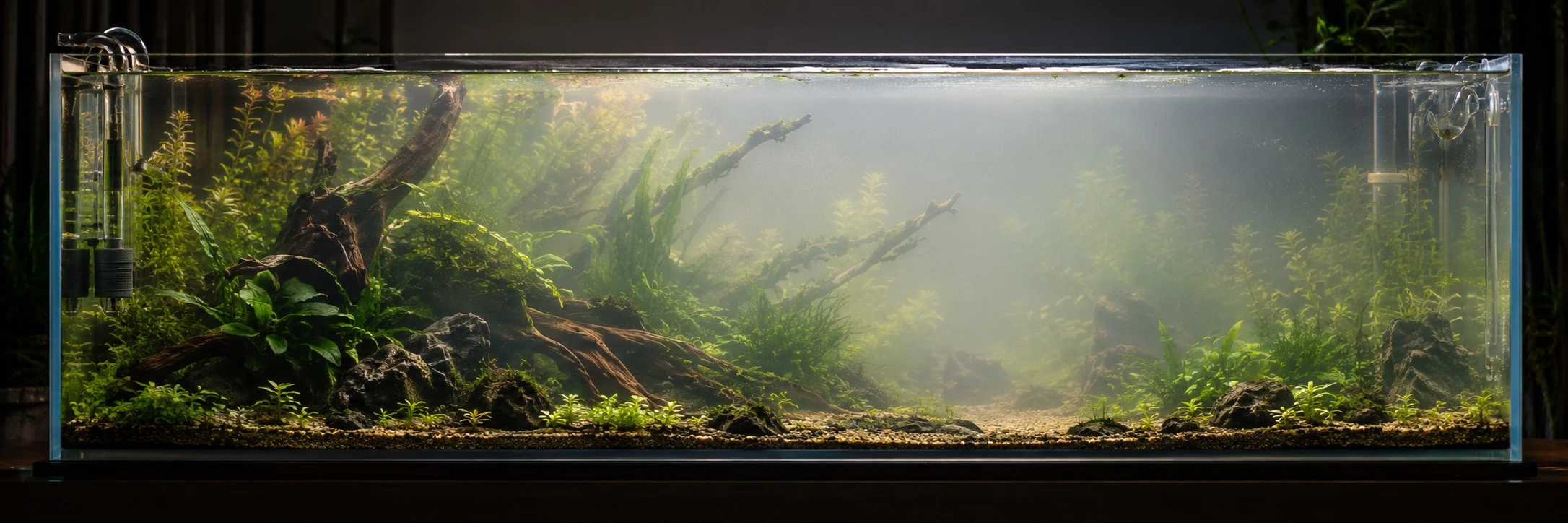
The tank was clear yesterday and cloudy today. It is tempting to blame the filter straight away. That is one possibility, but disturbed substrate, microorganisms or algae can also change the appearance. Start with the animals, the colour of the water and what changed recently. It is easier to choose a useful response when you know which problem you are investigating.
Start by collecting these details
When did it begin? Was substrate added or disturbed, feeding increased, or all filter media replaced? Viewing water in a clean container against white can help distinguish colour. Test ammonia and nitrite: appearance cannot measure them. Do not dismiss rapid breathing or surface gathering as normal for a new tank. Check filter operation, surface movement and temperature. Provide appropriate water changes or aeration when needed and seek help identifying the cause.
White or grey haze
If you added substrate and the water turned white, suspended particles are one possibility to check. If you replaced all the media during service, changes in biological conditions also deserve attention. Similar-looking haze can have different causes. The timing, recent work and tests help you decide what to investigate.
Green water
Green water can differ from algae growing on the glass. Suspended single-celled algae can colour the water. Assess lighting duration, direct sunlight, nutrient input and plant condition together. Replacing foam or buying a stronger motor is not a universal algae solution. Equipment such as UV can be useful in selected cases but needs correct sizing and instructions. Address the conditions that keep causing the problem.
Brown or tea-coloured water
Wood and other natural materials can release colour, which differs from particle haze. Do not attribute every darkening to wood: inspect decaying material, changed odour and water tests. If colour reduction is the goal, appropriate water changes or selected media may help. If ammonia, nitrite or maintenance is the problem, colourless water does not prove it has been solved.
What should you avoid changing together?
Replacing the whole filter, emptying the tank and adding several products makes diagnosis harder. Do not combine treatments without compatibility guidance. Clarifiers do not establish biological capacity instantly.
Example: white haze after maintenance
After maintenance, consider whether the substrate was disturbed or all media replaced. Suspended particles and changed biological conditions call for different investigation, and appearance alone does not diagnose either. Follow tests and behaviour; prioritise appropriate intervention if conditions deteriorate.
Frequently asked questions
Does a clarifier finish the problem?
Improved appearance does not prove the cause is resolved. Check compatibility and water tests.
Can a photograph identify the cause definitively?
Tests, animal behaviour and recent changes usually provide necessary extra context. For the basic jobs of filtration, see our Aquarium Filter Guide.
What should you record in NeoMa?
Record colour, onset and recent maintenance. Photograph from the same angle because changing lighting can mislead. Include ammonia, nitrite, temperature, breathing behaviour and any products added.
How can you tell it helped?
Check haze, test trends and breathing. Do not treat lighter colour as the entire resolution. If it returns, reassess feeding, debris, lighting or maintenance according to the suspected cause.
Following this in your own tank
A photo, test results and recent changes make the haze easier to interpret together. Keep the first explanation open to revision; colour alone is not a diagnosis. Consistent feeding and maintenance records can help reveal when it returns.