Choosing and Planting Aquarium Plants: Start with Your Tank
The plant looks beautiful in a photograph. But is that photographed aquarium like yours? It is easy to choose the appearance while overlooking the lighting, CO₂ and maintenance behind it. A useful beginner plant is one whose care you can sustain in your own aquarium. An “easy” label does not mean a living plant needs no care.
This guide helps freshwater aquarists choose their first plants or revise a planting plan. The goal is to understand placement and care, rather than hand everyone the same shopping list.
Describe your aquarium before buying plants
Do you inject CO₂? What are the lighting model, aquarium depth and schedule? Which substrate is installed? Consider water temperature, existing livestock and the time available for maintenance. “Low-light plant” alone leaves too much of that picture unanswered.
You may love the appearance of a fast-growing stem plant yet dislike regular trimming. Ease of growth does not make it a good fit for that preference. Conversely, a slow-growing plant does not necessarily have a problem because you see no new leaf after a few days. Our low-tech and high-tech guide connects equipment choices with the routine they involve.
What does an easy plant label tell you?
Categories such as Tropica’s Easy, Medium and Advanced provide a starting point for assessing lighting, CO₂ and care demands. They are not a universal standard used identically by every supplier, nor a guarantee of success. Read the description for the particular species or variety.
Less demanding plants may be sensible for a starter tank without injected CO₂. A planted aquarium is possible without injection, but the speed, dense carpet or strong colour in a showcase photograph should not be assumed. Our light, CO₂ and nutrient balance guide explains why those expectations belong with the setup.
Four examples of different growth forms
These examples illustrate placement and maintenance differences. Their final size and appearance depend on conditions. Confirm the full name of the plant you buy; another species from the same genus may have different needs.
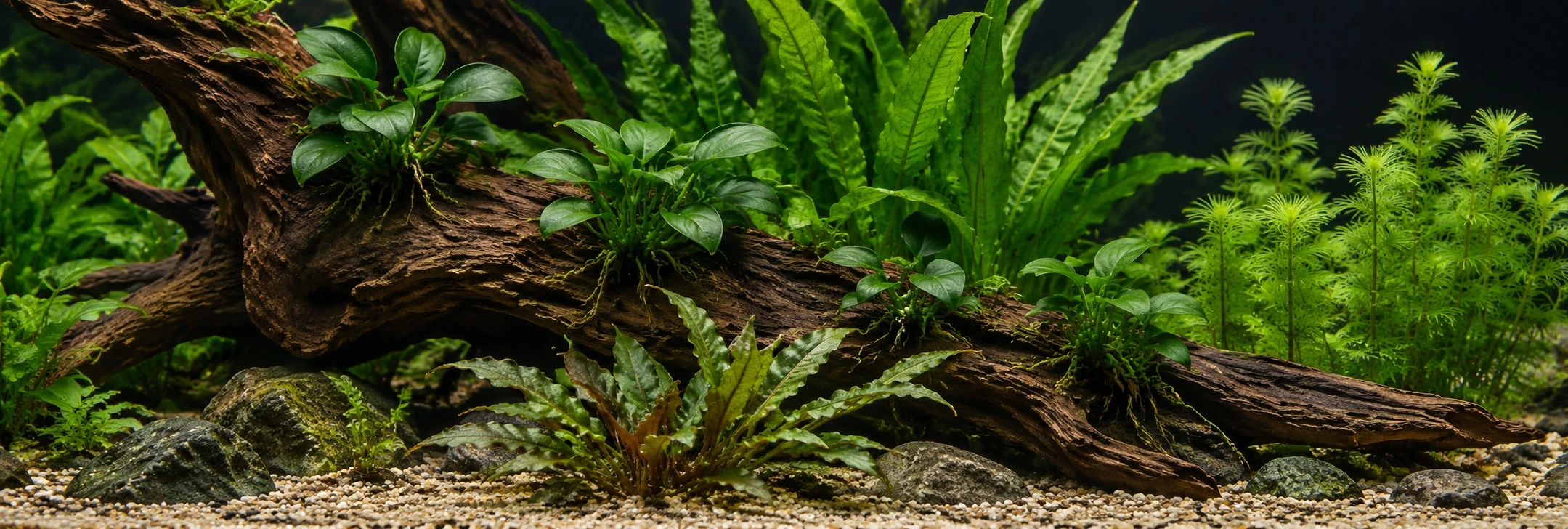
Anubias barteri var. nana: A slow-growing rhizome plant suited to considering for shaded areas. It can be attached to wood or rock. The rhizome is the stem section from which roots and leaves develop; do not bury it in the substrate.
Microsorum pteropus (Java fern): Another rhizome plant for wood or rock, with longer leaves. Allow for its eventual footprint in a small aquarium. Keep the rhizome exposed; plants do not all need planting into the substrate.
Cryptocoryne wendtii ‘Green’: A rosette option planted into the substrate, with relatively low light demand. Allow room for its growth. The small size of the specimen in a shop does not establish its mature size.
Limnophila sessiliflora: A fast-growing stem example that can be considered for background or side groups. Plan for trimming. In weaker light it may become leggy; do not attribute every appearance problem solely to a missing fertiliser.
Prepare pots, bunches and tissue cultures appropriately
Check the supplier’s preparation instructions. Gently separate a potted plant from its transport pot and growing material; remove transport rings from bunches where present. Remove tissue-culture growing medium as directed. Packaging does not determine the plant’s placement.
Cutting all roots to one length or dividing every species into identical portions is not a general rule. Follow the plant’s growth form and product instructions. A tissue-culture rhizome plant still needs an exposed rhizome.
Use the plant’s structure to guide placement
Place stems individually in groups without crowding them. Plant rosette roots while avoiding excessive burial of the growing centre. Secure rhizome plants to wood or rock without crushing the stem. Account for shading below any floating plants.
In an unstocked aquarium, a low water level can make planting easier. Keep plants damp and refill without disturbing the substrate. This is not advice to nearly drain an occupied aquarium: plan work around livestock, filtration and the heater’s required immersion level.
Take a starting photograph rather than repeatedly uprooting plants
Record the plant’s name, addition date and location. Use comparable angles and lighting for later photographs. Look at the direction and condition of new growth and whether placement suits the plant; an older leaf changing does not by itself identify a particular deficiency.
Changing lighting, CO₂ and fertilisation simultaneously makes it harder to learn what helped. Check identity, placement and planting first. Extensive deterioration or distressed livestock also calls for attention to water quality, beyond a plant photograph.
Adding plants does not by itself establish that a new aquarium is ready for fish. The checks in our nitrogen cycle guide remain a separate part of preparation.
Build a planting arrangement you can maintain
Check that growth does not obstruct filter intakes or equipment access. Watch for heavy surface shading and groups shading each other as they develop. Our lighting guide helps you consider what reaches the plants, rather than lamp output alone.
In your NeoMa tank journal, note planting dates, names and a placement photograph. Keep trimming and setting changes in the same history. That makes later choices more informed by the conditions of your own aquarium. Establishing a sustainable arrangement with a few suitable plants may be a better start than filling every gap with a different species.