

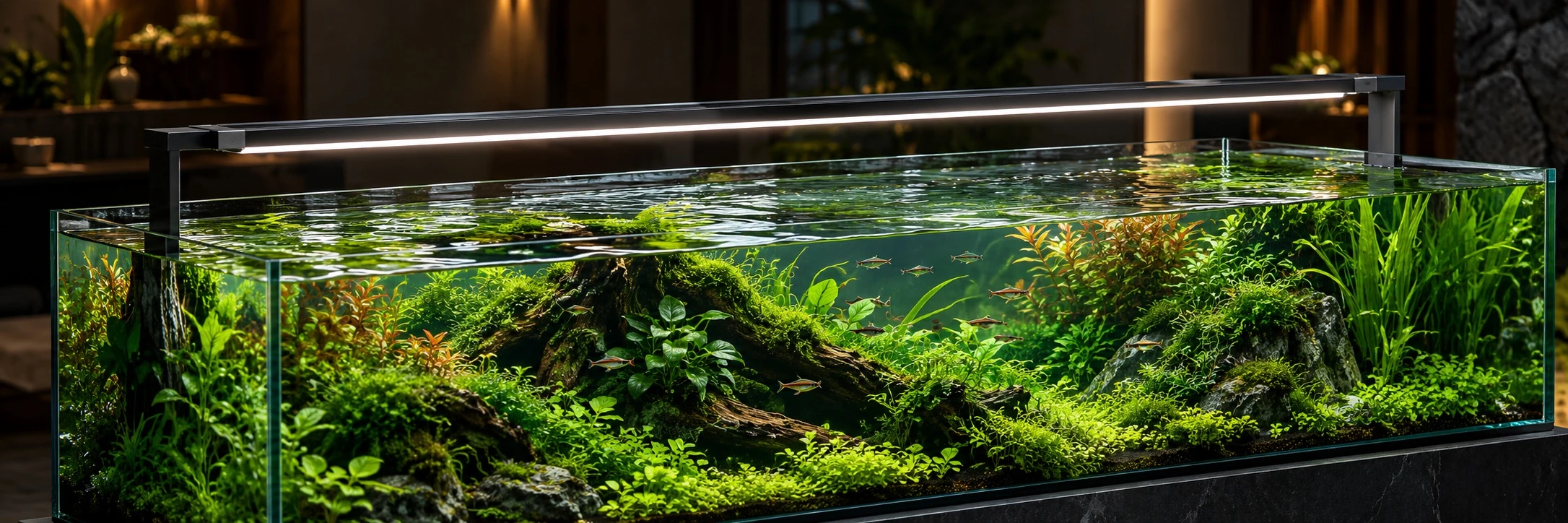
Choosing Aquarium Lighting: Watts, Lumens, Kelvin and PAR
Two fixtures have the same wattage. One looks brighter; the other says “full spectrum.” Which should you buy? Start with your tank dimensions and intended plants, then consider how light reaches those plants. No single number on the box makes that decision for you.
An aquarium light fixture includes the light source, housing and connections. It shapes the view and supplies light for plants. A fish-focused aquarium and a densely planted layout may need different things.
Gather these details first
Tank length, front-to-back width and water depth.
Plant species and positions: on the substrate, attached to wood or growing in shade.
Your CO₂ plans and the maintenance routine you can sustain.
Cover glass, floating plants and shadows from large rocks or wood.
The fixture's mounting method, supported length and controls.
Volume alone leaves out important details. A shallow, wide tank and a narrow, tall tank of equal volume present different distances and areas to light. Giving a supplier your dimensions and plant list is more useful than asking only whether a lamp works for 100 litres.
Watts describe electrical power
Two LED fixtures drawing the same power can differ in efficiency, optics and distribution. Higher wattage therefore does not guarantee better plant growth across different fixtures. Rules developed around fluorescent watts per litre may also be misleading when applied directly to different LED designs.
Lumens describe output weighted for human vision
Lumens can help with broad comparisons, but total output does not tell you how much light a plant receives at the bottom. The same lumen figure can come from different spectra and distribution patterns. The light reaching a plant can vary between the centre, corners and different depths. That is why we need to look at where the light goes as well as its total output.
Kelvin describes colour appearance
The Kelvin rating relates to the warmer or cooler white appearance of the light. It is not a plant-growing score. Two lights with the same colour temperature can have different spectra and output. Choose a look you enjoy, but do not assume a particular Kelvin rating guarantees successful growth.
PAR helps us discuss light at the plant
What hobbyists call a PAR reading is usually PPFD: the number of photosynthetically relevant photons reaching a given area each second. Traditional PAR covers 400–700 nanometres, and PPFD is commonly expressed in µmol/m²/s. The useful question is where and under what conditions it was measured.
A centre reading taken close to a fixture in air is not the value at the bottom of your aquarium. Look for depth, mounting height, output setting and whether readings were taken underwater. There is no single ideal value for every plant either; species, position and other conditions matter.
You do not need to own a PAR meter to keep a planted tank. Clear manufacturer data, comparable aquariums and healthy new growth can inform your decisions. Treat a phone light sensor cautiously rather than assuming it is equivalent to a validated underwater PAR measurement.
A bright centre can hide dark corners
A fixture matching the tank's length may still provide poor front-to-back coverage. One narrow bar over a wide tank can leave the edges weakly lit. Raising it may widen the spread while changing intensity at the plants. Any mounting adjustment should account for both safe installation and distribution.
If only a carpet plant in one front corner grows tall and sparse, check local shading before increasing the whole tank's output. Similar changes can also involve nutrition or adaptation. One struggling patch is a reason to investigate, rather than an automatic instruction to buy a stronger light.
Which controls are useful?
Dimming lets you start with a more moderate setting and make smaller adjustments later. A timer removes much of the variation caused by switching the light manually. Check how the programme behaves after a connection failure or power cut. Reliable settings matter more than an attractive app interface.
RGB controls and sunrise effects can personalise the view. They do not guarantee healthy plants or an algae-free tank. Likewise, a “full spectrum” label should not replace measurement data, practical controls or mounting that suits your aquarium.
How many hours should the light run?
A single duration without tank context is incomplete advice. A 5–6-hour light window can be a cautious starting point for a newly planted aquarium. Treat that as a starting reference rather than a permanent prescription. Intensity, plant choice, CO₂ and progress all need consideration. Repeatedly extending the schedule without recording the response gives little useful feedback.
Longer hours may not solve poor distribution. Investigate whether enough light reaches the plant in the first place. Preserve a dark resting period for livestock instead of leaving a viewing light on throughout the night.
Check installation and electrical safety
Follow the manufacturer's mounting, clearance and ventilation instructions. Do not assume a fixture tolerates splashes or condensation unless its rating and instructions support that use. Provide a drip loop so water cannot follow a cable towards the socket, and keep connections dry. Avoid handling electrical equipment with wet hands; disconnect the relevant devices before maintenance. Stop using damaged cables or connections.
Five questions to ask before buying
How will this fixture cover my tank's length and width?
Are there light measurements under conditions comparable to my intended setup?
Can I reduce output, and does the schedule run reliably?
Do the mounting and water-exposure requirements fit my aquarium?
Will I be able to record and compare the adjustments I make?
NeoMa's setup planning video, in Turkish, shows the move from a desired landscape to equipment decisions. Choose the light as part of that aquarium, rather than expecting it to fix the whole system. Recording the starting settings and later changes makes the tank's response much easier to understand.
Sources
Follow this in your own aquarium
NeoMa Aquatics is an aquarium management application for keeping tank profiles and maintenance history together. Use the setup profile for lighting and CO₂ information, and journal records for the changes you make. Open your tanks and records.
For another part of the setup, see Choosing Aquarium Dimensions.