

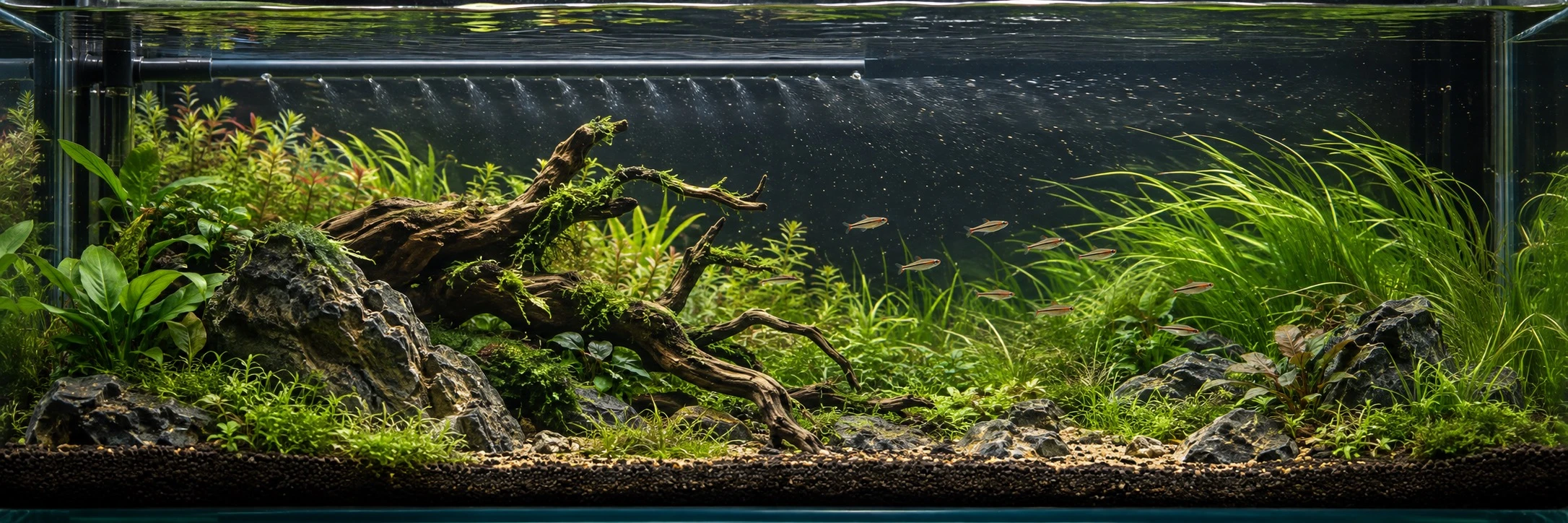
The box says 600 L/h. It sounds powerful, but what does it mean in your tank? It describes a volume of water moved per hour. You can still have a strong jet near the outlet and debris collecting in another corner. Start with the number, then look at where the water travels and how the animals behave.
Flow rate and current are different
A narrow outlet can produce a concentrated jet, while another design distributes similar flow more broadly. Plants bending near the outlet do not prove good circulation elsewhere. Debris may still accumulate behind hardscape. Examine outlet direction and obstructions. Aim for circulation appropriate to the animals, rather than flattening all the plants. Observe behaviour, but do not assume current is the only cause of hiding or surface gathering.
Why can operation differ from the label?
Check how the manufacturer measured the labelled value. In your installation, hoses, media and accumulated debris can affect flow. Matching L/h numbers from two brands may not mean matching results in your setup. An air pump’s air output is also a different measurement from a water pump’s flow.
How many tank volumes per hour are enough?
Comparing tank volume with flow can help an initial assessment, but no universal turnover multiplier guarantees suitability. Feeding and stocking differ, as do media capacity and maintenance. NeoMa’s flow guide on the calculators page can help you start. Complete the decision by checking intake safety, media space, animals and circulation in the actual layout.
Checks when flow weakens
First check intake guards and foam deposits, then outlets and tubing. Follow shutdown instructions before accessing the impeller. After assembly, check routing, valves and basket seating. If maintenance restores flow, a larger filter was not the first solution needed. Rapid clogging calls for reassessing feeding, debris load, fine media and access for cleaning.
What if current is too strong?
Use adjustment methods permitted by the model. An appropriate spray bar or outlet direction may distribute current. Do not restrict pumps arbitrarily with valves: safe adjustment is model-specific. Intake protection and outlet-current control are separate tasks.
Example: a strong jet and a dirty corner
Plants bend near the outlet while debris collects opposite it. This alone does not prove the motor needs upgrading. Check direction, obstructions and maintenance. Observe again after one change. Changing outlet, media and filter together makes it difficult to tell which action helped.
Frequently asked questions
Does moving water prove enough capacity?
No. Consider stocking and ammonia-nitrite monitoring as well.
Can I stop current at night?
Address appropriate adjustment and noise rather than routinely switching filtration off. For the basic jobs of filtration, see our Aquarium Filter Guide.
What should you record in NeoMa?
Record model, cleaning date and outlet direction. Photograph debris accumulation and note whether flow changed after maintenance, a layout adjustment or new media.
How can you tell it helped?
Compare the same locations afterwards: less debris in the distant corner, gentler local current and suitable animal movement. Recurrent problems call for checking renewed blockage rather than repeatedly increasing motor power.
Following this in your own tank
Observe different parts of the tank with a clean, correctly installed filter to establish a baseline. Compare later changes at those same points. Following outlet direction and maintenance can be more informative than choosing a bigger motor every time flow weakens.