

Preparing Tap Water for an Aquarium: Chlorine and Chloramine
You left a bucket of water overnight. Is it now ready for the aquarium? Standing time alone does not establish suitable preparation for every source. The disinfectant used, water chemistry and preparation method matter. In particular, do not rely on “it stood overnight” for chloramine.
This guide focuses on freshwater replacement and top-up water. Our water change guide covers the maintenance process; here we examine the water that will enter the tank.
Why separate chlorine from chloramine?
Water suppliers may use chlorine or chloramine to control microorganisms. Water prepared for human consumption is not necessarily suitable for fish and biological filtration without treatment. These disinfectants can harm livestock and useful microorganisms.
Chloramine should not be considered safely removed simply by standing or aeration. Obtain current treatment information from the supplier; if it is unknown, record that uncertainty. Smell and clarity do not establish the absence of disinfectant.
Read beyond “water conditioner”
Does the label clearly state its role for chlorine and chloramine? Is the product suitable for freshwater and the livestock? Does it explain dosing volume and how to add it? Use those questions to read the instructions.
A bacterial culture, fertiliser or pH product is not a dechlorinator merely because it is sold for aquariums. Some products have several roles, but their instructions need to establish them. Do not transfer a capful from another brand’s video: concentrations and caps may differ.
Preparing water separately makes the process clearer
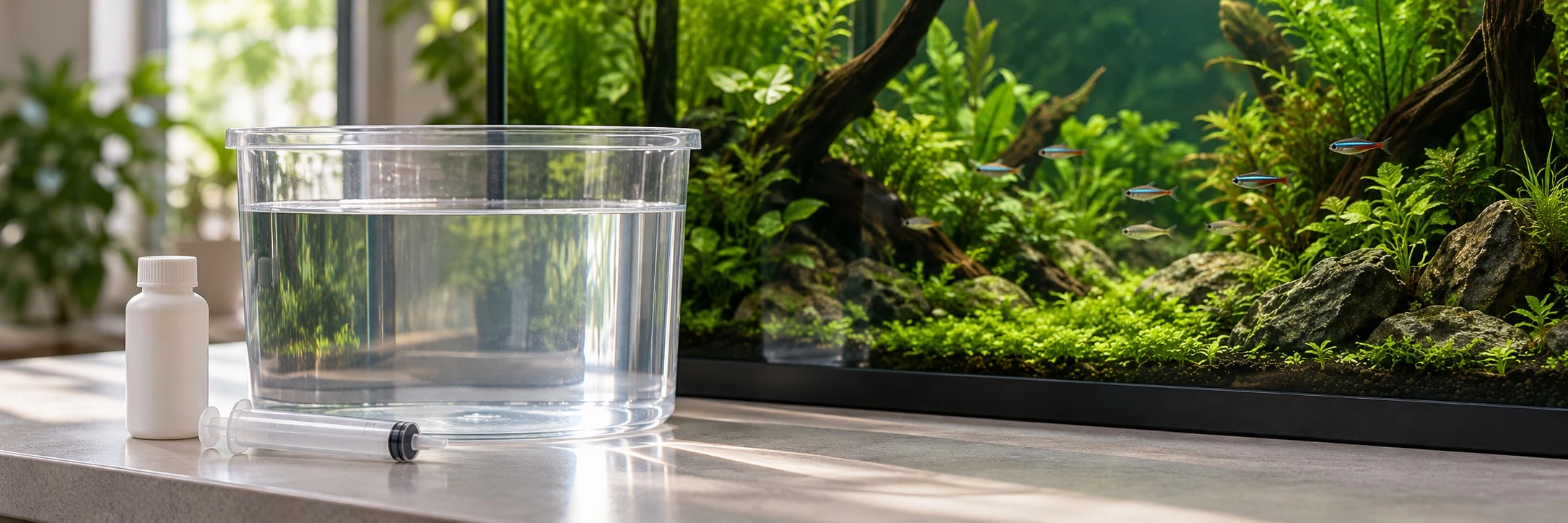
Use a clean aquarium-dedicated container without detergent residue. Measure the replacement-water volume. Apply the product using its stated volume and method and complete any mixing or waiting instructions. Make temperature and chemistry suitable for the tank.
Products permitting direct application to the tank may give a different dosing basis for that method. Do not assume every product always uses either replacement-water volume or the whole aquarium volume. Separate preparation, when practical, makes it easier to establish what was applied to how much water.
Extra product does not establish better preparation. Avoid stacking products; follow instructions and any aeration cautions. For small volumes, an appropriate measuring tool is easier to track than an estimated amount from a cap.
Chloramine can connect to an ammonia reading
Breaking down chloramine can introduce an ammonia/ammonium load. Repeated ammonia results after adding water deserve a source-water check and a review of the conditioner’s role, rather than automatically blaming a dirty filter.
Check compatibility between the product, test method and reading time. Product effects or the distinction between total and free ammonia can matter with some methods. Do not automatically dismiss a positive reading as false; consider behaviour, pH, temperature and repeat testing. Removing disinfectant does not establish a mature biological cycle. Our nitrogen cycle guide covers that separate requirement.
Domestic filtration and RO need checking too
Do not assume domestic filtered water is suitable simply because it passed through a device. Review what the system is designed to remove, cartridge maintenance and output water. Minerals and buffering matter alongside disinfectant control.
RO/DI or very low-mineral water may require preparation appropriate for the livestock. pH alone is insufficient; assess KH and GH too. This guide does not prescribe one product or mixing ratio for every source. The goal is a consistent method you can measure and repeat.
If fish look unwell after adding water
Stop adding new water and review its preparation. If fish show clear breathing distress, increase surface movement and aeration and stop injected CO₂. Check temperature, pH, ammonia and nitrite. Include disinfectant testing if available, and establish whether the kit reads free or total chlorine.
If disinfectant exposure is suspected, use a suitable product according to its emergency instructions and seek experienced help. If a further water change is needed, do not add the same suspect water without correct preparation. Trouble after a change is not automatically chlorine exposure: temperature or chemistry differences and other problems can produce similar behaviour. Persistent distress or deaths require experienced aquatic veterinary or specialist support.
Make preparation part of the routine
In your NeoMa tank journal, connect the water source, prepared volume, product and dose, time added and subsequent observations. Note a new source or product as a change in the routine.
Good preparation is more than “I added conditioner”. A suitable source, the correct product role, measured volume, compatible temperature and chemistry, and observation afterwards work together. Our biological filtration guide explains why the working system needs protection alongside the animals.