Necessary cookies keep the site working. With your permission we also load analytics (Google Analytics, Microsoft Clarity) and advertising (Google AdSense). Declining does not limit the guides or your account.
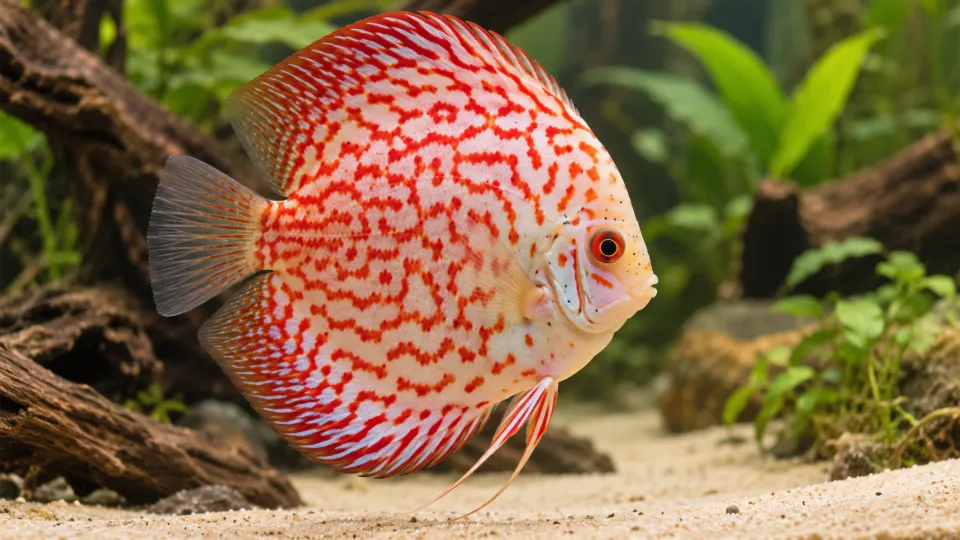
The red pattern and pale background of a Pigeon Blood Discus draw attention immediately. To choose a healthy fish, however, watch how it behaves within the group before judging its color: does it feed readily, swim comfortably and hold its own around other fish? Pigeon Blood is a domestic discus color-form label, not a separate wild species. Here we explain what the pattern can—and cannot—tell you.
What is a Pigeon Blood discus?
It is a domestic discus form, not a separate wild species. Record the domestic form within Symphysodon, adding breeder origin when known. Colour and pattern distribution can vary within a trade label. A photograph cannot establish exact genetic ancestry or predict offspring colour.
The main discus guide covers group planning, water and feeding. Pigeon Blood care starts with that routine rather than a special water recipe for colour.
How do you tell males from females?
Red intensity, a pale background and pattern shape are not reliable sex tests. Forehead shape and pointed fins are also insufficient alone. In mature fish, the breeding papilla and observed egg laying provide more useful evidence.
Two fish staying together are not automatically a confirmed pair. Egg laying identifies the female; the companion still needs separate evidence of male sex. Ask about egg development and previous fry when buying a proven pair. Recording a juvenile as unsexed is more useful than a confident guess.
Choosing a Pigeon Blood discus
When choosing between similarly sized Pigeon Blood fish, look beyond the red colour. Does the fish approach food, swim comfortably and hold its fins open? One fish remaining in a corner while the rest of the group is active is worth asking about before purchase.
Learn which food the fish accepts and the water conditions it has been kept in. Take a baseline photograph under consistent lighting for later comparisons. A single mark in a photograph is insufficient to identify a disease or genetic explanation.
Use the main discus guide for the care plan
See the main discus guide for group, temperature, tank dimensions and plant selection. Pigeon Blood does not need a separate colour-specific water recipe. Retain adult swimming and turning space, food access for every fish and routine waste removal. Do not increase lighting, feeding or temperature merely to enhance pattern.
Tank mates and group safety
When keeping domestic discus forms together, size, condition and food access matter more than colour names. Assess new arrivals through a separate quarantine and observation plan. For other species, compare sustainable shared temperature, adult size and feeding competition against the main guide’s compatibility criteria. A “discus compatible” label alone is insufficient.
Trade form, pigmentation and fry nutrition
Pigeon Blood has no separate wild distribution. Its trade name does not establish breeding history within Symphysodon; without parental records it cannot identify a wild species, genotype or expected percentage of offspring patterns.
Dark spots described as “peppering” should not be diagnosed from one photograph as parasites or an inherited disorder. Flat pigment spots differ from raised growths, tissue loss and spreading lesions. Compare baseline photographs under the same light alongside feeding, breathing and water measurements; spots alone do not justify medication.
Early feeding on parental mucus remains part of the rearing plan. Hatching, access to parents and additional food intake are separate stages. Research on discus does not guarantee success or establish a fixed separation day for a particular Pigeon Blood line. Follow general preparation in the main discus guide.