Necessary cookies keep the site working. With your permission we also load analytics (Google Analytics, Microsoft Clarity) and advertising (Google AdSense). Declining does not limit the guides or your account.
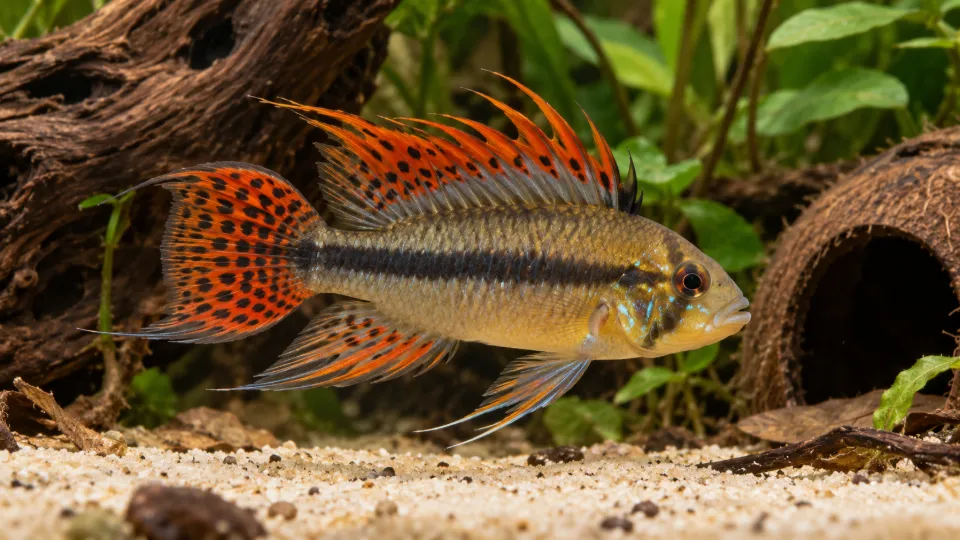
The red fin patterns of Double Red Apistogramma are easy to notice, but they are not exclusive to males. Females in some selected lines can also show prominent red markings. Sexing therefore depends on maturity, body structure and breeding behavior considered together. Even a correctly identified male and female will not necessarily form a compatible pair.
Sexing Double Red Apistogramma cacatuoides is not that simple. Red fin markings are not exclusive to males: females in red-selected lines can carry them too. Assess the whole fish rather than treating colour as the answer.
Is Double Red a separate species?
No. Double Red is a colour form of Apistogramma cacatuoides. Names such as Double Red and Triple Red describe selected colour patterns; they do not identify separate Apistogramma species.
Double Red therefore does not need a completely different care system. Its basic care, behaviour and breeding are assessed through A. cacatuoides. Use the main Apistogramma Cacatuoides Care guide for water, aquarium layout and caves. Here, we focus on the sexing mistakes that the red form can create.
How do you sex Double Red apistos?
Look for several features together. Mature males generally have larger bodies, more developed fins and particularly extended dorsal-fin rays. Females tend to remain smaller; their yellow body colour and dark markings may become more pronounced during breeding.
In Double Red fish, fin colour is the part that can confuse this assessment.
Do red fins mean a male?
No. Females in red-selected cacatuoides lines can also show red fin markings. A rule of “red fins equals male” does not work, and carrying more red does not automatically identify the male either.
What should you look at instead?
Start with maturity. Young Apistogramma can be harder to sex because their fins have not finished developing. In mature fish, assess body size, dorsal-fin rays, overall fin development, body colour and behaviour together. No single feature should be treated as a definitive test.
If you are buying for breeding, ask more than “Is this a female?” A more useful question is: “What are you using to identify this fish as female?”
Does yellow colour identify a female?
A breeding female A. cacatuoides can develop a distinctive appearance, with stronger yellow colouring and dark markings. This is a valuable clue, but context still matters.
Colour intensity can vary with breeding state, stress and environmental conditions. Avoid replacing one shortcut with another by treating any yellow fish as a confirmed female. When breeding colour appears alongside maturity, body structure and breeding behaviour, the overall picture is more informative.
How should you choose a Double Red pair?
Selecting a male and female is different from selecting a compatible pair. Having one of each does not automatically mean they will accept each other. This is where the aquarium layout matters.
Provide caves, wood and sight barriers, with usable room for either fish to move away. A layout around an 80 × 40 cm footprint and 100–130 litres is one planning example for a male and female. Space alone is not enough, though: an entirely open layout can still leave one fish under constant pressure.
Volume tells you the size of the container. The layout influences how the fish can share that space.
One male and one female, or a harem?
You may encounter advice to keep one male with several females. Do not apply it as a universal formula. Each additional female may need her own territory.
Adding females to a small aquarium does not automatically distribute aggression. Without sufficient space and sight barriers, it can create new conflicts. The main cacatuoides guide covers this in more detail; Double Red colouring does not remove the territorial behaviour.
If two Double Reds chase each other, are both male?
Not necessarily. Chasing does not establish that both fish are males. A female can defend a territory too, and during spawning or brood care she may drive even the male away from her cave.
Rather than immediately assuming a sexing mistake, look at the situation:
When did the chasing begin?
Is a cave being defended?
Is one fish continually hiding?
Can both fish eat?
Is there fin damage?
Brief territorial defence is different from one fish being kept under continual pressure.
Can a Double Red’s appearance change with time?
Yes. A juvenile’s pattern on the day you buy it is not a fixed picture of its adult appearance. Fish sold under the same trade name may not develop identical markings.
Before asking which fish is redder, check:
Body condition.
Fin condition.
Response to food.
Behaviour.
Age.
Breeder or line information, where available.
Make the colour choice after those checks.
What is the difference between Double Red and Triple Red?
These are trade names for selected red patterns or breeding lines, rather than scientific species names. A Triple Red label alone does not establish better quality, a particular adult appearance or a different care requirement.
Seeing the actual fish and, where possible, learning its breeding background is more useful than relying on the label alone.
What fish can live with Double Red apistos?
Choose companions using the needs of Apistogramma cacatuoides. Calm small fish using midwater and upper levels can be assessed where conditions overlap. Other dwarf cichlids and bottom-dwelling fish may compete for space, especially during breeding. Baby shrimp should not be considered safe.
When buying a Double Red, record age and the basis of your sex estimate alongside a photograph. For example: “Thought to be female because of smaller body size, yellow breeding colour and behaviour.”
That is more useful than recording only “female”. As the fish develops, you can revisit the original assessment. Keep those observations with photographs in the NeoMa tank journal, so the history includes what you have learned about the fish over time.
Trade labels and healthy selection
Do not assign Double Red a separate natural distribution; habitat and basic reproductive biology belong to Apistogramma cacatuoides. Mate-choice research on red-strain cacatuoides supports the observation that females can have red fin markings. This does not establish identical genotypes across all commercial Double Red lines.
Compare offspring at similar ages under the same lighting, linking parental identity, spawning date and development. Normal swimming, sound mouth and fin structure, and healthy growth must not be displaced by selection for red. A photograph likewise cannot establish that a structural problem is genetic.
The form label does not require a separate temperature, salt or medication programme. Breeding, egg care and first-feeding preparation follow the underlying species guide. Choosing a colour form does not reduce a territorial cichlid’s need for space and a separation option.