

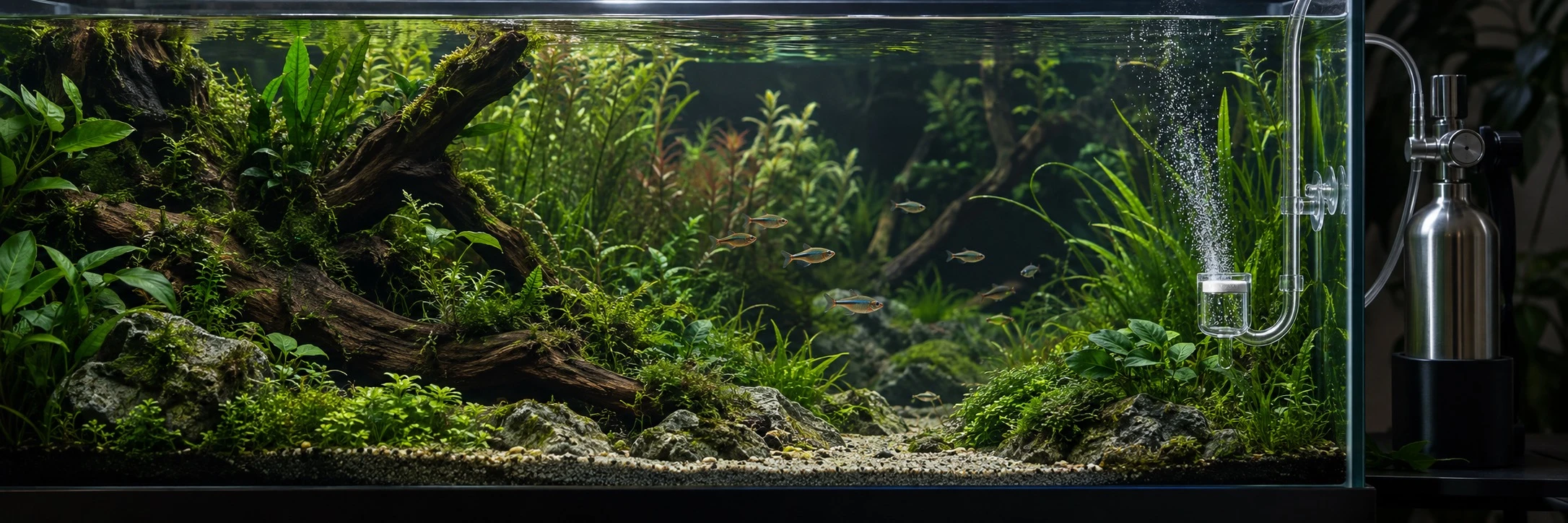
Setting Up Aquarium CO₂: Check Compatibility Before Turning It On
You connected the cylinder and bubbles are leaving the diffuser. Is the setup finished? Gas leaving the equipment does not establish that a suitable amount dissolves in the aquarium or that the timing works. A useful CO₂ setup combines compatible equipment with observation and a routine you can sustain. Copying the bubble count from another aquarium skips those checks.
This guide is for freshwater planted aquariums, particularly when installing a cylinder-based system. Biological and reaction-based kits can require different connections and shutdown methods; follow their own instructions. Consider your plants and lighting in our low-tech and high-tech guide. CO₂ injection is not assumed necessary for every planted aquarium.
What does each component do?
The cylinder stores gas; the regulator reduces pressure for the equipment downstream. A needle valve adjusts gas flow. A solenoid is an electrically operated valve that can switch with a compatible timer or controller. It does not measure dissolved CO₂. A bubble counter offers a visual reference for gas flow, rather than a dissolved-CO₂ test.
In-tank diffusers, reactors and inline devices require different arrangements. Check tubing and connection compatibility with the chosen equipment. A check valve helps prevent water travelling backwards through the gas line; check whether one is integrated and follow its mounting direction.
Our NeoMa bubble-counter video, in Turkish, accompanies this explanation. A count shown in a video is not your aquarium's prescribed dose.
Confirm compatibility before buying or connecting parts
A product labelled “CO₂ regulator” does not necessarily fit every cylinder. Match the cylinder connection standard, required seal, operating-pressure requirements and tubing dimensions. Different thread options on a product page do not mean the unit automatically fits all cylinders.
Some models combine a bubble counter and check valve, while timed control may require an additional controller. If there are two gauges, establish which shows cylinder pressure and which shows working pressure. Compare the supplied parts with instructions for the exact model. Do not force an incompatible fitting or choose adapters, seals or tightening methods by guesswork.
Read the instructions before opening a valve
Secure the cylinder against falling and keep it in a suitable ventilated place away from heat and direct sunlight. Pressurised-gas equipment involves more than a risk to the aquarium. Do not use damaged fittings; leave cylinder filling and equipment repairs to an appropriate service.
Follow your model's sequence for attachment, tightening, pressurisation and removal. A hand-tight connection on one model is not a rule for another. Do not alter or disable a safety valve. Raising pressure without control because gas is not coming out is not a setup method.
Use the manufacturer's recommended leak-check procedure at the connections, without contaminating aquarium water with checking fluid. If you suspect a leak or equipment damage, stop using the system and contact the manufacturer or supplier. Do not work on a pressurised connection hoping that extra tightening will fix it.
Give the diffuser an appropriate first start
Some ceramic diffusers need soaking before use; take the duration from that product's instructions. For inline equipment, check filter-hose compatibility, flow direction and installation requirements. Giving every device the same working pressure is not a sound starting point.
Choose a first run when you can observe the aquarium. Confirm that the filter actually runs and that water movement distributes the gas rather than leaving it concentrated around one location. Dense planting or changed filter flow can alter the result of an earlier arrangement. Our filter-flow guide is relevant to CO₂ installation too.
Compare the timer schedule with actual operation
For a cylinder system with a solenoid, plan a schedule that avoids unnecessary dosing in darkness. Consider lighting, dissolution and distribution together, rather than assigning every tank the same start time. An “off” setting is not the same observation as gas actually stopping. Watch the first switching cycle.
A timer does not automatically stop gas in a system without a solenoid. Do not improvise by clamping tubing or blocking a gas-generating kit's outlet. Use a control method appropriate to that system's design. Recheck schedules after an outage or programme change.
A drop checker is not an instant distress alarm
A drop checker needs the appropriate indicator solution and correct installation. Its colour response lags behind changes. Turning the flow up because the colour looks unchanged after a few minutes can be misleading. pH/KH charts can also mislead where other acids and buffers affect the water. One colour or pH drop should not be treated as the same safe dose in every aquarium.
Record small changes separately and follow both plant growth and animal behaviour. Our light, CO₂ and nutrient guide develops the broader balance question.
Animal distress ends the adjustment experiment
If you see rapid gill movement, surface gathering or a sudden behaviour change, stop CO₂ injection and increase surface movement and aeration. Do not wait for a drop-checker colour. These signs do not identify excessive CO₂ alone; temperature, ammonia/nitrite and recent interventions also need consideration. Seek experienced help for marked or persistent distress.
Installation continues through maintenance records
Record equipment models, a photograph of the connection arrangement, lighting/CO₂ times and the setting you changed in your tank journal. After a cylinder replacement, diffuser cleaning or filter maintenance, recheck actual operation instead of assuming the previous result remains unchanged.
You can keep those notes and maintenance history together for the tank in NeoMa. Before responding to poor plant growth by adding more gas, review what changed recently. The aim is a manageable routine with healthy livestock and plant growth you can assess, rather than the largest bubble count.